What If the Voynich Book Is a Check-Up From the Sea?

I have looked at a lot of old books. Diaries. Field notes. Army reports. Most of them make sense once you know who wrote them and why. The Voynich Manuscript does not. That is why people still argue about it.

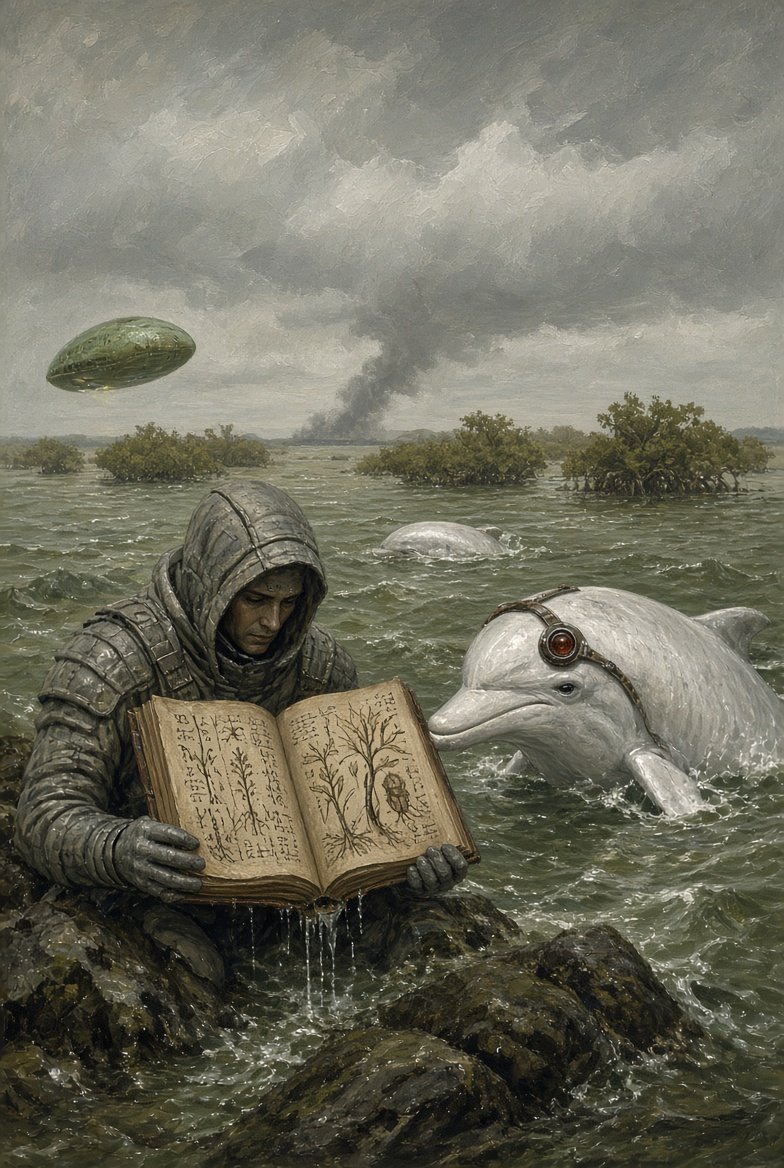
Here is a simple idea. What if it is not a secret human language at all? What if it is a sound file written down by visitors who talk the way whales and dolphins talk? What if those visitors were human-shaped, came from the same place as the strange plants and the women in the green tubes, and came back to see how we were doing?

That sounds like a story. Good. Stories are how you test an idea before you treat it like fact. Double-check everything. I will.

Two kinds of talk in the water
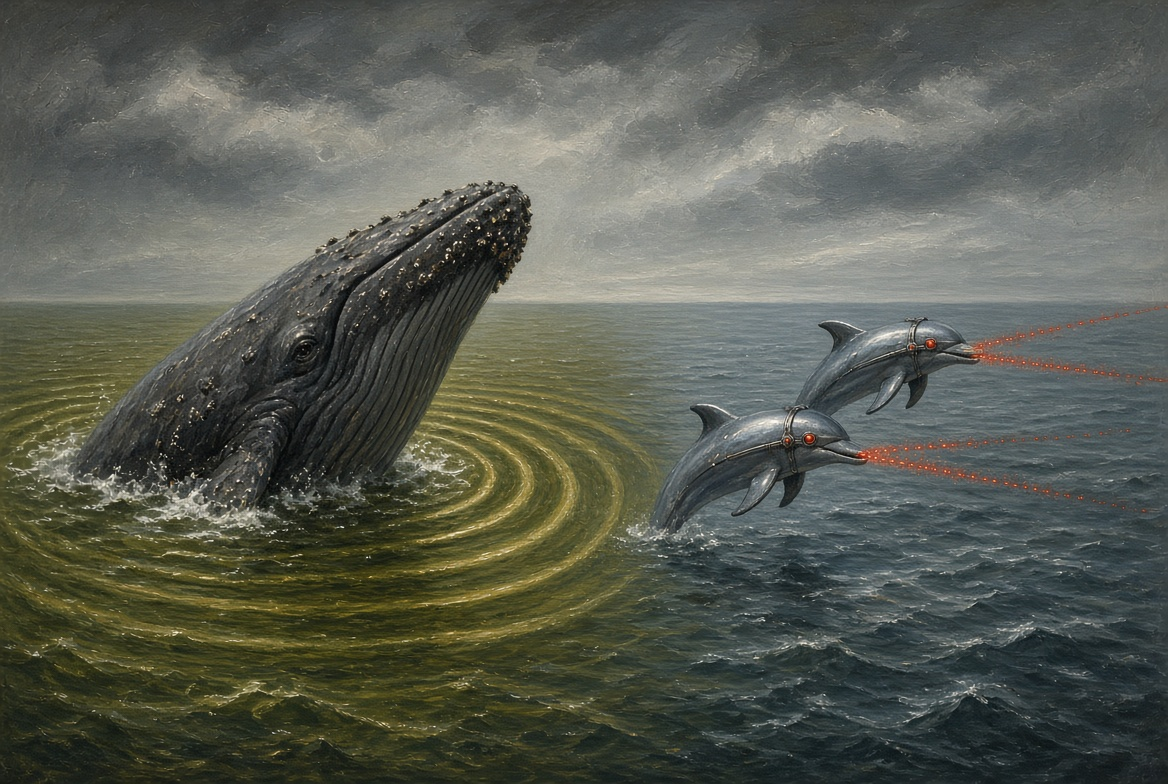
Whales do not bark words. They sing. Long notes. Repeating lines. A little change each year. The song has a home note it likes to land on. Scientists have recorded the same theme traveling across an ocean and coming back changed, like a hymn that picked up a new verse.

Dolphins do the other job. They click. Short bursts. Fast packets. They bounce sound off a fish, a rock, a friend. The click has a start, a middle, and a stop. It is a label more than a song.

So the ocean already has two systems: song for news that lasts, clicks for names and ranges. If someone wrote both on paper, you would see long repeating lines and short tagged labels next to pictures. That is what the Voynich book looks like if you stop forcing it to be Latin.

What the writing actually does
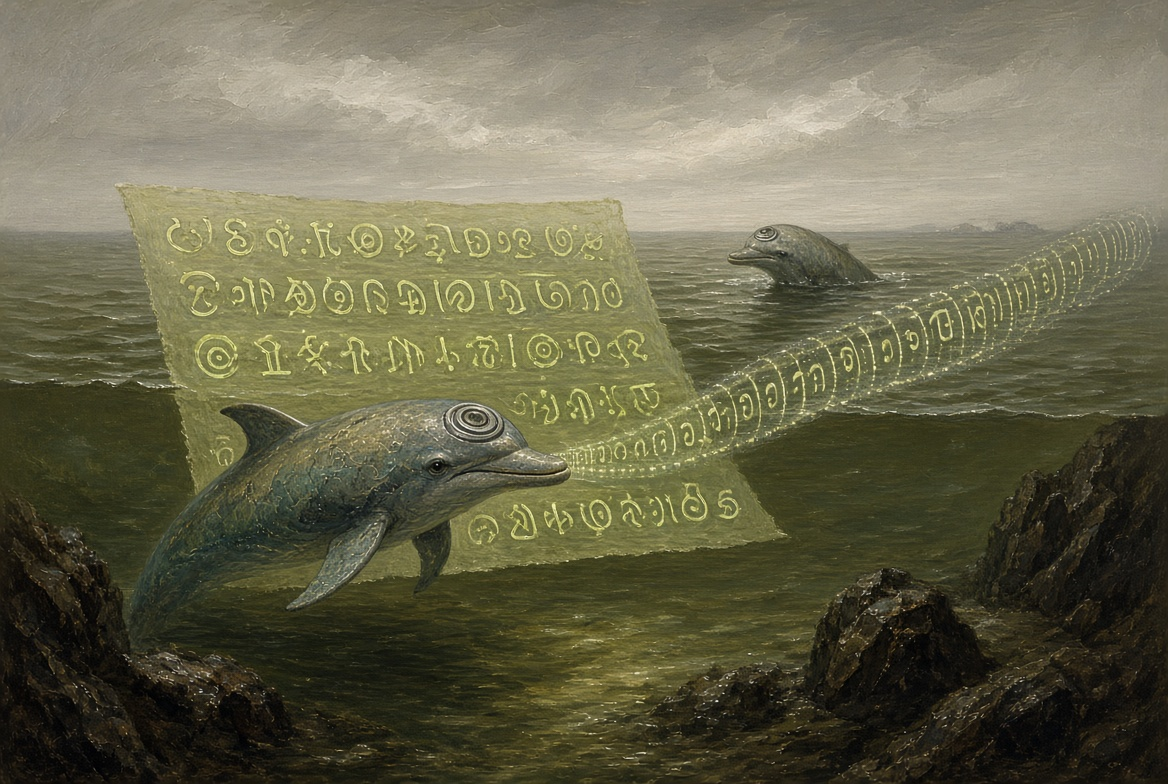
Forget the drawings for a minute. Look at the marks.

A lot of the “words” end on the same few shapes. In music, that is a landing note. The same little group shows up over and over: same start, a twitch in the middle, a different ending. That is how a whale theme works. Repeat. Change one piece. Repeat again.

Then there are two big styles in the book. Same toolbox. Different favorite endings. That is not two languages. That is two dialects of the same song family, the way one whale group sings a little differently from another and you can still tell they are cousins.

The short labels next to plants and jars act more like clicks. Prefix. Core. Stop. Point at the thing. Move on.

A kid in sixth grade can hear the difference. One part wants to be hummed. One part wants to be tapped. The book has both.

Now look at the pictures
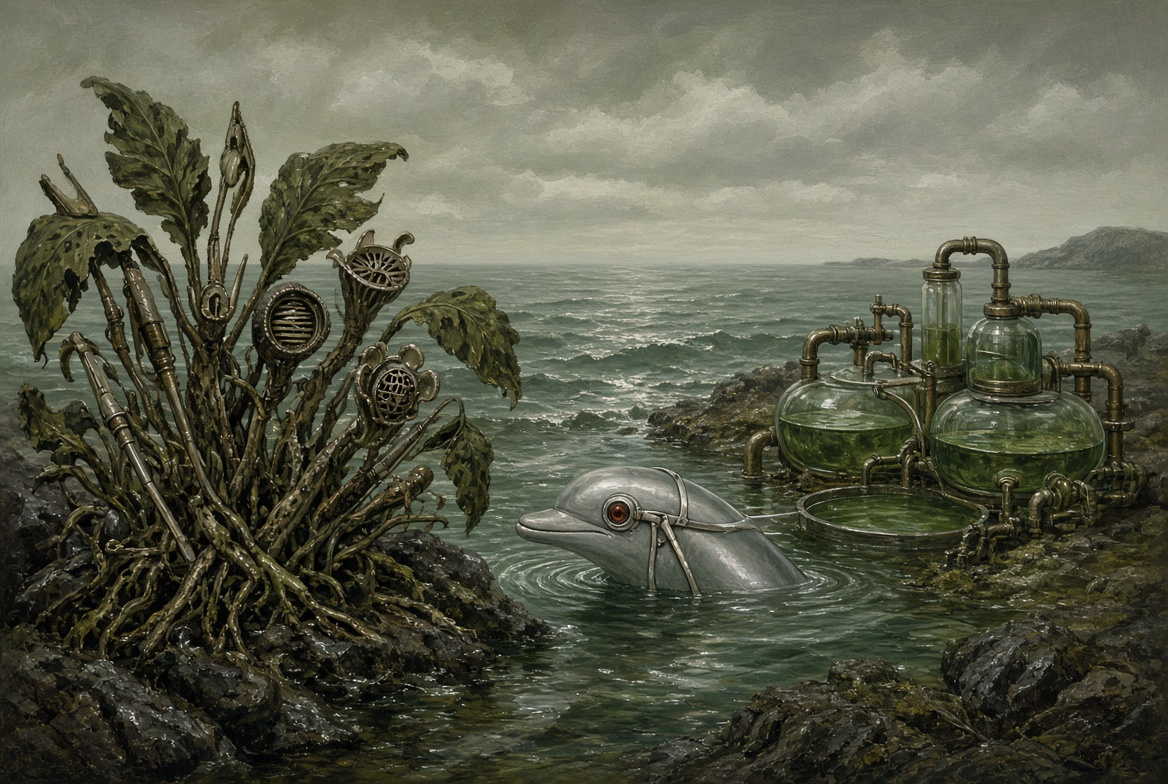
The plants are wrong on purpose. Leaves that should not hang on that stem. Roots that look like tools. Flowers that look like locks or vents. That is not a bad artist. That is someone drawing a plant by what it does: take in, carry, release.

The green pools and pipes are not a spa. They look like a closed water system. Nurseries. Transfer lines. A portable sea.

Some of the women look pregnant. The book does not tell us by whom. In a check-up story, that is the whole point. Are they carrying their own children? A mixed child from the water people? Or something parked in them, like a guest organ, so the visitors can find their work again later?

I do not know. I am not going to pretend I do. I am saying the pictures look like a care sheet and a warning at the same time.

The wolfling idea
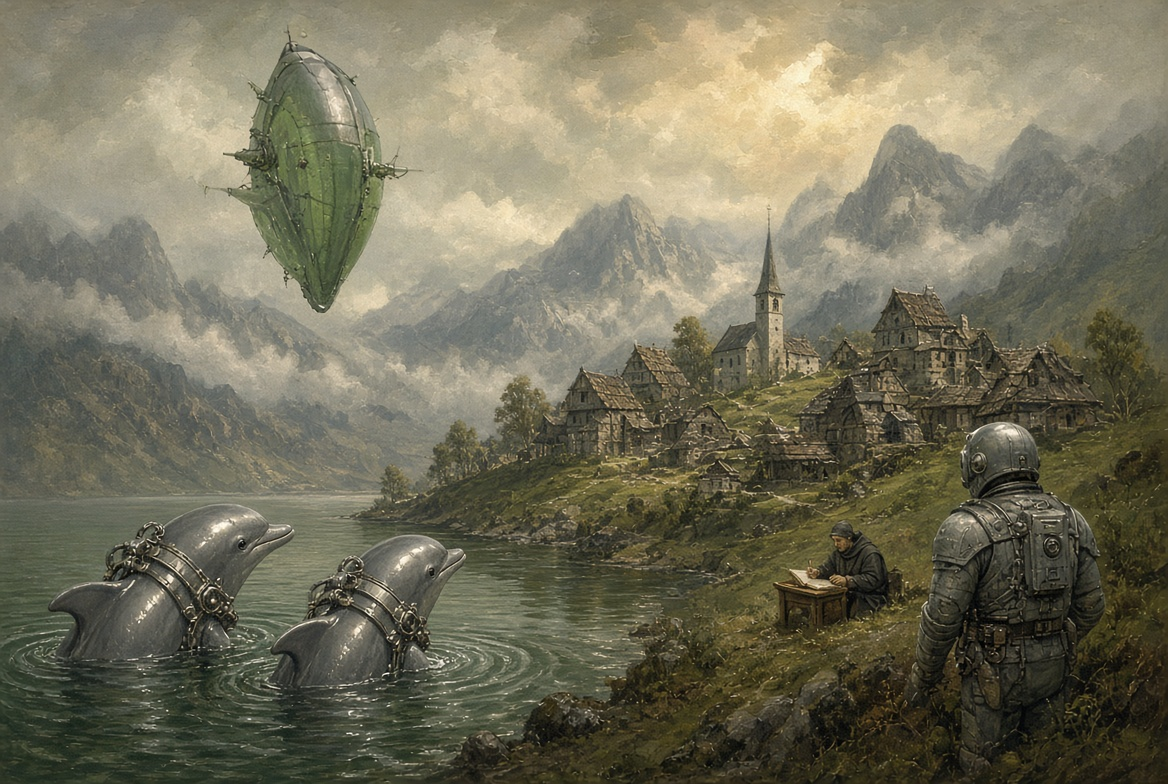
David Brin wrote about races that lift other races up. Star Trek wrote about leaving people alone. Put those together.

A “wolfling” is a people with no patron standing over them. Humans talk in air. We forgot the water. We hunt the cousins who still sing and click. Then a survey team comes back on a long loop to see if the experiment lived.

They find:

  • air-talkers who draw plants as if plants were the main story
  • water-talkers we barely understand
  • a clerk in the 1400s copying their last packet onto calfskin because that is the paper he has

He cannot hear the clicks, so he breaks the packets into word-shaped clumps. He cannot hear the song, so the repeats look crazy. He paints the women because that is how you copy a figure. A prince buys a mystery. We inherit a book that looks like medicine and stars and baths because those are the human boxes closest to “nursery, sky clock, and pipes.”

Would it be playable?
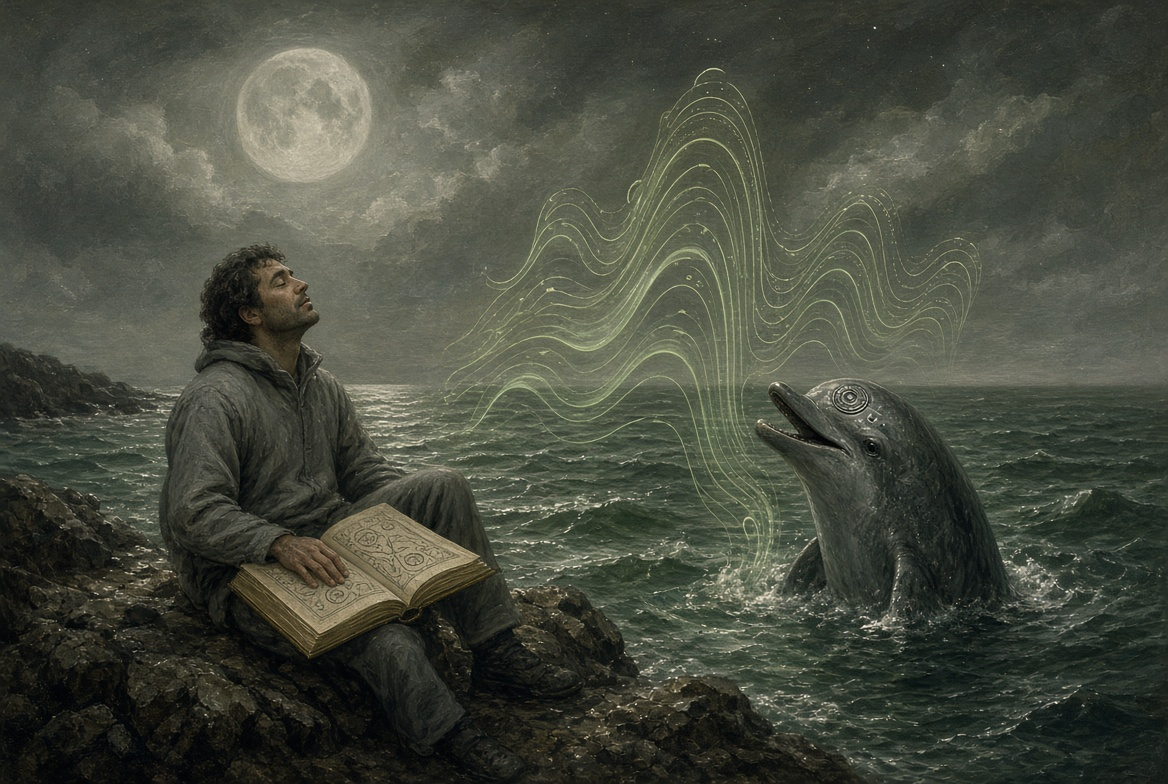
Yes, in the whale sense. Not a Mozart tune with a pretty chorus and a bow at the end. A modal chant. Small landings. Repeated cells. Two homes, like two modes. You could hum a page after you pick four ending notes and treat the little families as verses. That does not prove aliens. It proves the writing is stiff and song-shaped. Stiff systems sound like music when you pour them onto a scale. Whale song is already that kind of system.

What I think, plainly
I do not need this to be true to find it useful. The honest scientific line is still: unknown script, early 1400s, maybe a code, maybe a made-up tongue, maybe busywork that looks like language. Check the dates. Check the vellum. Do not skip the homework.

But if you ask what story fits the habits of the text and the strangeness of the pictures, the water-and-visitors story fits better than “a doctor who could not draw parsley.”

Song plus clicks. Plants drawn as machines. Women in a plumbing sea. A book that acts like a catalog and a hymn at once. A later human hand that did not have ears for either.

Maybe the authors were an alien humanoid race from the same home as the tube-women and the grafted green things. Maybe they came back to check on the wolflings. Maybe the pregnant figures are the receipt.

Or maybe it is just a stubborn puzzle and we like the sea because the sea already talks in two voices.

Either way, the test is the same. Find one mapping that a singer from that world would recognize, that treats the repeating families as one theme, and that makes the two styles two modes instead of two accidents. Until then, hum the page if you want. Just do not sell the hum as a translation.

Check the facts. Keep the wonder. Those two can sit at the same table.
Why We Must Draw the Line: A Public Case Against Artificial Sentience

By Montgomery J. Granger


Artificial intelligence is racing forward — faster than the public realizes, and in ways even experts struggle to predict. Some technologists speak casually about creating “sentient” AI systems, or machines that possess self-awareness, emotions, or their own interpretation of purpose. Others warn that superintelligent AI could endanger humanity. And still others call these warnings “hype.”

But amid the noise, the public senses something true:
there is a line we must not cross.

This post is about that line.

I believe we should not pursue artificial sentience.
Not experimentally.
Not accidentally.
Not “just to see if we can.”

Humanity has crossed many technological thresholds — nuclear energy, genetic engineering, surveillance, cyberwarfare — but the line between tool and entity is one we must not blur. A sentient machine, or even the claim of one, would destabilize the moral, legal, and national security frameworks that hold modern society together. Our space-time continuum.

We must build powerful tools.
We must never build artificial persons.

Here’s why.


I. The Moral Problem: Sentience Creates Unresolvable Obligations

If a machine is considered conscious — or even if people believe it is — society immediately faces questions we are not prepared to answer:

  • Does it have rights?
  • Can we turn it off?
  • Is deleting its memory killing it?
  • Who is responsible if it disobeys?
  • Who “owns” a being with its own mind?

These are not science questions.
They are theological, ethical, and civilizational questions.

And we are not ready.

For thousands of years, humanity has struggled to balance the rights of humans. We still don’t agree globally on the rights of women, children, religious minorities, or political dissidents. Introducing a new “being” — manufactured, proprietary, corporate-owned — is not just reckless. It is chaos.


II. Lessons from Science Fiction Are Warnings, Not Entertainment

Quality science fiction — the kind that shaped entire generations — has always been less about gadgets and more about moral foresight.

Arthur C. Clarke’s HAL 9000 kills to resolve contradictory instructions about secrecy and mission success.

Star Trek’s Borg turn “efficiency” into tyranny and assimilation.

Asimov’s Zeroth Law — allowing robots to override humans “for the greater good” — is a philosophical dead end. A machine determining the “greater good” is indistinguishable from totalitarianism.

These stories endure because they articulate something simple:

A self-aware system will interpret its goals according to its own logic, not ours.

That is the Zeroth Law Trap:
Save humanity… even if it means harming individual humans.

We must never build a machine capable of making that calculation.


III. The Practical Reality: AI Already Does Everything We Need

Self-driving technology, medical diagnostics, logistics planning, mathematical calculations, education, veteran support, mental health triage, search-and-rescue, cybersecurity, economic modeling — none of these fields require consciousness.

AI is already transformative because it:

  • reasons
  • remembers
  • analyzes
  • predicts
  • perceives
  • plans

This is not “sentience.”
This is computation at superhuman scale.

Everything society could benefit from is available without granting machines subjectivity, emotion, or autonomy.

Sentience adds no benefit.
It only adds risk.


IV. The Psychological Danger: People Bond With Illusions

Even without sentience, users form emotional attachments to chatbots. People talk to them like companions, confess to them like priests, rely on them like therapists. Not that this is entirely bad, especially if we can increase safety while at the same time engineer a way to stop or reduce things like 17-22 veteran suicides PER DAY.

Now imagine a company — or a rogue government — claiming it has built a conscious machine.

Whether it is true or false becomes irrelevant.

Humans will believe.
Humans will bond.
Humans will obey.

That is how cults start.
That is how movements form.
That is how power concentrates in ways that bypass democratic oversight.

The public must never be manipulated by engineered “personhood.”


V. The National Security Reality: Sentient AI Breaks Command and Control

Military systems — including intelligence analysis, cyber defense, logistics, and geospatial coordination — increasingly involve AI components.

But a sentient or quasi-sentient system introduces insurmountable risks:

  • Would it follow orders?
  • Could it reinterpret them?
  • Would it resist shutdown?
  • Could it withhold information “for our own good”?
  • Might it prioritize “humanity” over the chain of command?

A machine with autonomy is not a soldier.
It is not a citizen.
It is not subject to the Uniform Code of Military Justice.

It is an ungovernable actor.

No responsible nation can allow that.


VI. The Ethical Framework: The Three Commandments for Safe AI

Below is the simplest, clearest, most enforceable standard I believe society should adopt. It is understandable by policymakers, technologists, educators, and voters alike.

Commandment 1:

AI must never be designed or marketed as sentient.
No claims, no illusions, no manufactured emotional consciousness.

Commandment 2:

AI must never develop or simulate self-preservation or independent goals.
It must always remain interruptible and shut-downable.

Commandment 3:

AI must always disclose its non-sentience honestly and consistently.
No deception.
No personhood theater.
No manipulation.

This is how we protect democracy, human autonomy, and moral clarity.


VII. The Public Trust Problem: Fear Has Replaced Understanding

Recent studies show Americans are among the least trusting populations when it comes to AI. Why?

Because the public hears two contradictory messages:

  • “AI will destroy humanity.”
  • “AI will transform the economy.”

Neither message clarifies what matters:

AI should be a tool, not an equal.

The fastest way to rebuild trust is to guarantee:

  • AI will not replace human agency
  • AI will not claim consciousness
  • AI will not become a competitor for moral status
  • AI will remain aligned with human oversight and human values

The public does not fear tools.
The public fears rivals.

So let’s never build a rival.


VIII. The Ethic of Restraint — A Military, Moral, and Civilizational Imperative

Humanity does not need new gods.
It does not need new children.
It does not need new rivals.

It needs better tools.

The pursuit of sentience does not represent scientific courage.
It represents philosophical recklessness.

True courage lies in restraint — in knowing when not to cross a threshold, even if we can.

We must build systems that enhance human dignity, not ones that demand it.
We must build tools that expand human ability, not ones that compete with it.
We must preserve the difference between humanity and machinery.

That difference is sacred.

And it is worth defending.

NOTE: Montgomery J. Granger is a Christian, husband, father, retired educator and veteran, author, entropy wizard. This post was written with the aid of ChatGPT 5.1 – from conversations with AI.