An Inquiry Into Values: Zen and the Art of Motorcycle Maintenance (Long read)

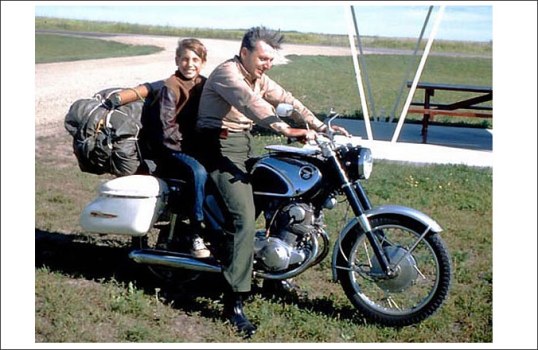
Robert M. Persig died recently; he was the author of the metaphysical classic with the inverted title above. I did that to the title because you almost never get the subtitle when people mention “Zen and the Art of Motorcycle Maintenance.”

pirsig2

Without the subtitle one gets the impression that the book is about fixing two-wheeled vehicles. The Zen part, unless you know anything about Zen Buddhism, is usually completely ignored.

For me, the most important part was the “inquiry into values.” Eventually, I got that motorcycle maintenance was the vehicle through which the author discusses philosophy with us. Values are beliefs, feelings and actions which are important to us, the most important of which are actions. I was very intrigued by this title.

The author uses motorcycle maintenance as a metaphor for defining quality. Quality in one’s life. Quality of thought, of writing, of being.

My older brother turned me on to the book in my early teens. I wasn’t mature enough at the time to appreciate the metaphor. In fact, developmentally, I could not have understood or appreciated it. I, like most adolescents and teens, lived in a literal world. Our humor was literal (MAD magazine), our vocabulary was literal (slang notwithstanding, “bad” was good), and our social world was literal (if you could touch, taste, smell, see and hear it, it existed).

Zen was as far from literal as you could get.

In my late teens I began to become more aware of perceptions other than my own. I began to be curious about existentialism. I grew as a Christian and as a young man. At 17 I became interested in motorcycles as a means of transportation.

My father was into “bikes,” and owned a Honda Gold Wing (1979 GL1000), a BMW 750 (1975) and a 1958 Zundapp (not working).

SaltedGoldwingMedium

The Zundapp 250 was a German mountain climber, so had a short gear ratio that increased the torque. Once running it was fast (not quick) and did much better than its small engine size suggested. The trick was getting it running.

Zundapp 250

My father noticed my interest in the bike from the get-go. I asked him about it incessantly. I’d been driving cars (not my own) since I was 16, and the summer of my junior year in high school was coming up and my mother had gotten me a job through the university she worked for. I would be picking jojoba beans in the hot, arid fields of Southern California about 15 miles from my home and I needed a way to get to and from the job.

My father’s deal was simple, get the bike running and then I could use it in the summer.

Challenge accepted!

The clutch plates were rusted together. Rust is a bad sign when opening up the guts of a machine. It meant the bike had been neglected and left outside for God knows how long. This would later prove to be its undoing, but initially it was just something to overcome.

It took a few weeks, but I finally got the thing running. It had a beautiful, throaty sound in open throttle. Waaaaaaaaaaaaah! Not too high pitched, either, like the little rice-burner dirt bikes that everyone seemed to have. It was masculine and bold, but not unnecessarily loud like a hole in your muffler.

My father had taken the paintable parts off of the bike while I was working on the clutch plates and he’d painted the thing near candy apple blue. Gas tank, fenders and frame. It was a sight!

I could not stop at a traffic light or gas station without at least one person giving me the thumbs up with a head nodding broad smile. Conversation starter? This was So Cal. Bikes were IT. And this thing turned heads.

Sadly, it didn’t run for long, as the rust thing reared its ugly head chronically. The fuel tank was rusted. We tried pretty much everything, lastly putting an in-line fuel filter in place so I could clear the line frequently. But it wasn’t enough.

The several weeks I had my own transportation was enough for a teenager to be smitten.

I had learned the inner and outer working details of a motorcycle in a very intimate way. I understood the relationship between the parts. I learned the holistic philosophy of one thing affecting the whole, a mechanical butterfly effect.

I knew the sounds, shakes and smells necessary to diagnose issues before they became problems. I learned the limits and safe limits of the being that was the machine under me.

I learned to respect the machine. I learned that the weakest part of any system was the human part, either in design or in maintenance or in operation, the human was always the weakest link. I learned to trust what I knew about the thing, and then act on what I knew.

By the time I had started to read the book again I was already half way through it with my knowledge and appreciation. The literal layer of Zen was mine. I got it. I was it.

Then the book took a turn for me.

I had epiphany after epiphany.

What was QUALITY? How did I know?

What was EXCELLENCE? How did I know?

Big, juicy questions at just the right time in my life.

Once you learn how to question, the world literally opens up. Everything becomes interesting and a puzzle or challenge to be solved or met.

That’s about the time I went to college. Perfect timing.

The summer of my freshman year in college my father helped my purchase a Yamaha 360. An upgrade in engine size from the Zundapp, but not a perceptible improvement in power. The Yam’ was peppier, and quicker, but the speed and power of the 250 Zundapp would have almost been a match for it.

19XX_Yamaha_350

I used the 360 to go up the California coast a spell to a summer camp counseling job near Ronald Reagan’s Rancho De Cielo (Ranch in the Sky), in the hills overlooking Santa Barbara.

It was a handy machine, and a babe magnet of sorts.

In the end, when it was time for me to return to college, since I didn’t have the means to take it back to Alabama with me, I loaned the bike to a German friend of mine from college who wanted to stay in CA for another several weeks before heading back to Alabama. He left the bike with a family friend in CA before he returned to school.

Just before my third year of college I became financially independent. I got a lot of grants and loans for school, and had enough to buy my first brand new motorcycle, A Yamaha SECA 550. A four cylinder beast. Quick, fast and furious!

Yamaha XJ550 Seca

White features with red trim (my favorite color combo!). A very stylish sport bike, the 550 had an abbreviated racing faring. Just enough to hide behind while laying down on top of the fuel tank, while trying to break new land speed records, aerodynamically reaching speeds unmentionable. There are limits to a speedometer.

Every bike has a sweet spot. A speed at which it becomes one with the universe. A speed at which there are virtually no vibrations. With my Dad’s BMW it was 75 miles per hour. It was like a dream. I never rode it by myself, but rode plenty of times as a kid hanging onto my father from the back. It was a smooth ride to begin with because at that time BMW’s had drive shafts and not chains to drive the rear wheel.

1972-r75-5

The BMW seemed to float and fly at 75. I knew that was how fast we were going because I could see the speedometer over my father’s shoulder. It was bliss. Just hearing the hum of the shaft driving engine, wind winding around my helmet, fluttering my shirt and jeans.

As described in Persig’s book, you become one with your environment, you are not separated from the scenery, and you are in it, a part of it, as opposed to taking trips in a car, where the windshield becomes more of a movie screen, a separation between you and nature.

The sweet spot for the 550 was 65 miles per hour, exactly! 64 m.p.h. was no good. Shakes. 67 m.p.h. was no good. Vibrations. But at just 65 it hummed. It flew. It loved the world at 65.

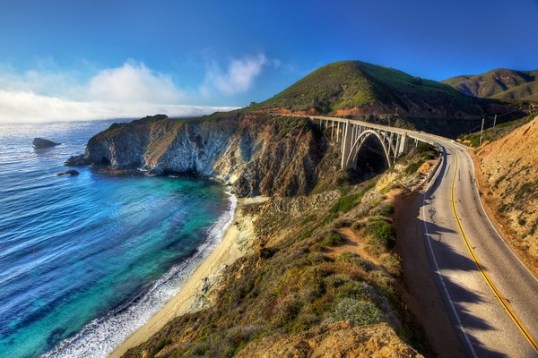
I took that bike up and down the California coast. I took that bike from San Francisco to Chicago to New Hampshire back down to Alabama and Florida, through Texas, back to California and then all over again. Alone.
pacch04

Literally from the red wood forests to the Gulf Stream waters, to the New York islands, this land was made for me and my bike.

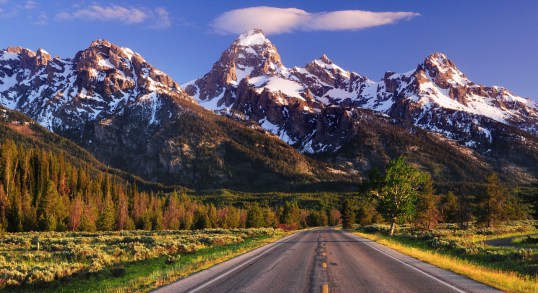
The most spectacular scene in my life on a motorcycle came when I rode through the Rocky Mountains. So vivid and beautiful, as if God had saved his best work for this one place on the planet. The only comparison I could make was the Swiss Alps. Well, in America, we don’t need no stinking Alps! We got the Rockies!
Rocky-Mountains-Street

As in the book, when you’re on the road lots of things can and do happen. Almost all of the things are a surprise. They are a surprise because if you take care of your bike like you take care of yourself, a beloved pet, or even a child, you know its tick’s and tock’s. You predict when it needs this or that. You pay attention to mileage and oil changes and tire pressure and chain tension. So, when something goes wrong, you are surprised, taken aback. What could possibly have gone wrong?

Nothing serious mechanically for me, ever.

Was it my careful Zen maintenance routine? Maybe. Fate? Maybe. Luck. No, not luck. Luck only comes into play when you’re NOT trying to do something. The only luck in motorcycle maintenance is self-made bad luck when you don’t do the right thing.

The book had me from “go” once I was mature enough to appreciate the concepts. The book helped me take care of my machine, and helped me develop my perceptions.

I wanted to experience arête, excellence. I wanted everything I did to be perfect, although nothing ever seemed to be that way unless I was on my bike, going here or there, on the open road, “bugs in my teeth.”

I last rode a motorcycle in 1987.

I had used up my nine lives, so-to-speak.

Thunderstorms on the open plains of Texas, with nowhere to hide. Large semi-tractor trailer trucks pushing waves of water, like shooting a pipeline in the Southern California surf, except if you wipe out on the road you are done.  You go faster in the rain and hydroplane and you’re done. You go too slow being passed by a semi in the rain and the wave pushes you over, and you’re done.

So, how do you get through it? Prayer. You pray you stay upright as the monster passes you. You pray that when you can see again you are still on the road. You pray for that lone overpass in the distance you can sprint to before the wave hits.

Heavy traffic in L.A., getting to a third job, eight lanes of bumper-to-bumper. Do you split traffic and play Russian roulette, or do you play it safe and risk becoming a pin ball? A little of each please, but go light on the splitting! Oh, and be careful of falling asleep in the So Cal heat and monotony of the thousands, no tens of thousands of vehicles, and exhaust, and dirt, and grime, and BUMP!

One time and one time only did I ever rear end anyone. It was on the 360, heading into Century City. Fell asleep for a split second, woke up to a bumper sandwich. It doesn’t take much. Maybe two or three miles per hour, and not enough time to react. I hit and the bike went over to the left. I let it go and then examined it for damage. None. Man behind me out of his car, “Are you alright?” “Yes, thank you,” I said. “Bike OK?” “I think so, thanks.”

You shake it off quickly and then get back on. Or else.

I fell asleep approaching Chicago once at dawn. The highway wasn’t too busy yet, and I had been riding for a very long time with just a few hours of sleep in an Iowa campground restroom. I had hallucinated myself through most of Iowa’s rolling hills to the east. I stopped once at a diner for food and coffee. The images my sleep deprived mind created were frightening. Winding roads fed into the giant mouths of dragons! Monsters grabbed and licked at me with chomping jaws!

I was grateful for the sun coming up. I was almost at my destination, but the sleep monster had me.

The next thing I knew my toes were bouncing on the turf of the median of the highway. My body was so stiff I had maintained my posture as the bike slowly glided off the road to the left. My hands still but barely on the hand grips, the accelerator gently returning to the off position.

I was probably going about 25 miles per hour when I woke up. I quickly pulled my feet up and could feel my whole body cringe, certain I was about to crash and then die.

I resisted the urge to apply breaks, either front hand or pedal rear. For applying breaks on grass could be the last thing you do unless going super slow.

I let the bike slow, and then gently stopped her and got off. Putting down the kick-stand I stood beside her, shaking.

Now what? I asked myself.

Now what are you going to do?

Years before, while on the 360 I was riding up the side of Mt. Rubidoux, in my home town with a childhood friend on the back. I hit a patch of gravel on a turn and had no choice but to lay the bike down. I wasn’t going fast, but I had lost the road. Once the contact part of the tires lose contact with pavement you are done. My friend hopped off, and then at the last second I let the bike go and it slid to a stop.

mtrubidoux

Without hesitation, my friend said, “Get back on.” I was just staring at the bike, heading into shock. He didn’t let me. He took my arm and led me to the bike. “Pick it up,” he said. “Let’s go.”

There was no discussion. I don’t remember saying a word.

I do remember thanking him later.

Now, standing in the grass median, which sloped gently toward the center, I remembered that Mt. Rubidoux event. I started up the bike, slapped myself hard once on each cheek, and then cursed at myself: “You stupid @#$%^#*&%$#! Do you want to die?” “NO!” I answered myself. “Then stay the %$#@ awake!”

Off I went, promising, and then keeping the promise, that I would never ride in that condition again, and I didn’t.

I kept a Walkman radio/cassette player in my jacket, and fed the earphones into my helmet. My pockets were full of tapes. To this day if I hear a song from one of them I flash back to the open road, on a bike, alone. Very relaxing.

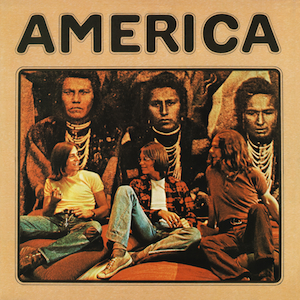
Billy Joel. Simon and Garfunkle. America. The Eagles. Willie Nelson. Chicago. And soundtracks, Jesus Christ Superstar, Annie, A Chorus Line, Godspell, Fiddler on the Roof. I would sing to all of them, which helped me stay awake, and alive.
America_album

Too many close calls. And then finally, in 1985, after my last summer camp job before graduate school in New York City, I met my future wife in the graduate housing lobby. Smitten at first sight. Still together, and remembering that first meeting like it was five minutes ago.

The tussled helmet haired California boy meeting the cosmopolitan sheik Long Island girl. She says she “knew” at that moment she was going to marry me. All I know is that the first girl I met in New York City might as well have been the last. No looking back.

The thing was that when we started dating and I offered to spur us around the City on my bike she wouldn’t have it. She wouldn’t even sit on the thing standing still.

“Why?” I asked.

It took many times asking that question to get an answer. Finally, she told me her best friend and neighbor, a boy, had died riding a quad in the woods behind their neighborhood while they were in Jr. High. She promised herself she would never get on a quad or motorcycle and she didn’t.

After grad school I returned home on my bike, alone. My future wife was doing three masters degrees on scholarship, and I had just done one. I spent a year in California with the Seca, but grew love sick and finally sold the bike to a friend for $1, and got myself back to New York and into a teaching career.

I taught health, physical education and occasionally “Life Skills.” I was also a Dean of Students, all in the New York City public high schools, mostly in Manhattan.

Academic freedom was alive and well, so as long as I taught the curriculum I could really add whatever else I wanted.

I added values education and a unit on spiritual health. I never preached to my classes. In fact, my lessons were never about me. When asked, I would defer. “Mr. Granger, what religion are you?” “That’s not important,” I would say. “What’s important is what you think and believe and act upon.”

Bayard_Rustin_Educational_Complex_main_entrance_18th_Street

Robert Persig’s book played prominently in my health and Life Skills classrooms.

The discussions on quality and excellence were lively and intense at times. My students could not stop talking about the subject as they left class. Discussions would never end. I gave them projects and outlets for their awakened passions and creative thinking.

Persig said no one can define quality or excellence, but we know it when we see it.

You can set grading criteria or rubrics, but do they capture the essence of a piece of work or art?

Spelling and grammar are elements of writing, but are they essential to something being special, or excellent?

Should I give grades or subjective narratives?

Does one learn better when they know there won’t be a final grade but a written evaluation? Or does the lack of a grade confound the competitive spirit of a straight “A” student?

Are we even ready to really learn anything substantial at 18, 19, 20 or even 21 years old?

This is the meat and potatoes of Zen and the Art of motorcycle maintenance: An Inquiry Into Values.

It is a gift that keeps on giving because there are no pat answers to the questions posed. To the inquisitive mind the book is a playground, a mental Disneyland.
zen-motorcycle-pirsig-post

Persig wrote other books, even a sequel to Zen. But the first book is a standalone classic that will forever spark the memories I’ve shared with you here, and that is an excellent A+ awesome job of the highest quality!

Pearl Harbor and Our Survival

On this, the 75th anniversary of the attack by Imperial Japanese on the U.S. Naval base at Pearl Harbor, Hawaii, we need to see the big picture. Learning from our past is challenge enough without compartmentalizing events rather than see the patterns.

pearl-harbor-1

We learned from WWII that appeasement doesn’t work. We learned from Vietnam that unless our political goals match our military goals we cannot win. We learned from Desert Storm that although it felt good to complete the mission, the mission wasn’t broad enough.

We’ll get to the Global War on Terror (a.k.a. Overseas Contingency Operations) in a minute.

We learned from the Marshall Plan that in order to make the world safe for democracy one must make an investment in peace. We learned that in order to keep the peace, by projecting power and influence, we needed to stay in Germany, Japan and Italy, for example.

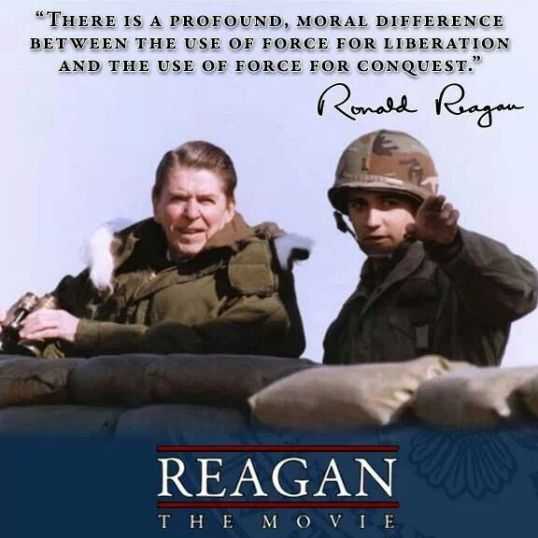
We learned there is a difference between using violence for conquest and using violence for liberation. We remain in countries we defeated over 70 years ago not as occupiers, but as liberators and friends. These friendships have survived because we share a belief in the principals of democracy.

reagan-1

It should be easier to see now therefore, those who would lie, cheat, steal, kill and maim to achieve their goals. It should be easy to see the tragedy of the commons and the evil of Islamization.

We share values (beliefs, feelings and actions which are important to us; the most important of which are actions) with our friends, and share nothing with our enemies; not even the value of life. Our enemies gladly die to take us with them.

So what is it about the anniversary of the attack on Pearl Harbor that can instruct us in our conflicts of today; less about the attack and more about how we defeated our enemy and where we went from there.

Simply, we pooled our resources, and then pulled our total effort into winning the war. We went so far as to intern Japanese Americans, not least because the spy for Imperial Japan for the attack on Pearl Harbor posed as a Japanese tourist.

There were no significant internal attacks on the U.S. by Japanese during WWII. Was it because we interred Japanese in America? Perhaps. Hind sight is 20/20, but in war, in order to survive, right and wrong sometimes take a back seat to what is necessary for survival.

Imperial Japanese Admiral Yamamoto’s statement while the attack took place reminds us of the futility of war: “I fear all we have done is wake a sleeping giant and then fill him with a terrible resolve.”

yamamoto

Fear is a powerful motivator, but not for our current enemies. They fear only not accomplishing their mission. They welcome death.

Our Imperial Japanese enemies also did not fear death and used kamikaze aircraft to fly into U.S. targets, killing the pilots. Imperial Japanese would rarely surrender, officers choosing instead to commit hari-kari or soldiers hopelessly charging into enemy fire.

We defeated the Imperial Japanese only when we used the most fearsome weapon imaginable. Being the first and only country to use atomic weapons is no badge of honor, but the lives saved cannot be counted adequately. One estimate is that over half a million American lives were saved by avoiding an invasion of Japan.

That’s good enough for me.

The Global War on Terror is a different beast than WWII, or any other conflict we have faced. Our political and military goals could not be more dissimilar, like Vietnam, but worse.

Our wishy-washy foreign policy that claims 1) The Global War on Terror is over; 2) There are no boots on the ground, and 3) We have made progress in terror fight, only pose to confuse the reality that our enemy is in fact winning.

Americans HATE to lose. We cannot ever accept defeat. We will resist to our last breath.

patton-3

Our way forward is not as simple as island hopping in the Pacific, or crushing the enemy after the Battle of the Bulge. We cannot simply nuke the bad guys into submission.

We must go back to the philosophy of December 8, 1941, the day after the attack on Pearl Harbor.  We must pool our resources, including those that did not exist in 1941, such as cyber and technological weapons.

We must see the enemy for who he is, lying (taqiyya), ruthless (murder all prisoners), immoral (OK to kill women, children and other innocents), and determined (willing to kill themselves for gain).

Until all Islamists are dead or no longer have the means or will to kill us we must defend ourselves.

Our full effort in this defense must include taking and then holding ground, like in WWII. It must include a Middle East Marshall Plan to help rebuild and then defend strategic areas. It must include establishing and then maintaining bases as power projection platforms from which we can defend our allies and interests, and influence our enemies.

The anniversary of the attack on Pearl Harbor is a day to remember those killed, wounded and who sacrificed for our liberty and freedom, but it is also a time to gain motivation and resolve that this and all our sacrifices shall not be made in vain.

Cuba: 51st US State

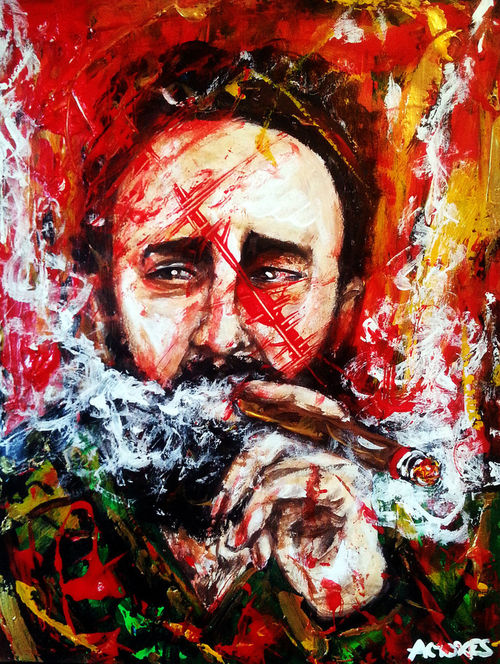
I don’t believe in dancing on graves, but if I did, I would dance on Fidel Castro’s. The dictator, 90 years old, recently died, and now vast memories of oppression and brutality rush to the surface.

castro-1

The death of Fidel Castro is a tremor before the quake – Raul is next, and then (peaceful) revolution to make Cuba the 51st US state.

Go ahead and laugh, scoff and make fun, but Cuba was once a US possession. The 1898 Treaty of Paris, which officially ended the Spanish American War, awarded Cuba, Guam, the Philippines and Puerto Rico to the United States from Spain.

rough-riders

Guam is still a US possession, and Puerto Rico is a US commonwealth, the residents of which are all US citizens. The Philippines were granted independence in 1946, after being liberated by the US from the Imperial Japanese at the end of WWII.

Cuba was granted independence by the US in 1902. The U.S. Naval Station at Guantanamo Bay, Cuba, has been in existence since 1903, when Teddy Roosevelt signed a lease agreement with the new Cuban government, by mutual consent. US Marines had landed there in June of 1898 in order to defeat the Spanish during the Spanish-American War.

In 1934, President Franklin Roosevelt signed a new lease agreement with Cuban leader Fulgencio Batista. The agreement states:

“Until the two Contracting Parties agree to the modification or abrogation of the stipulations of the agreement in regard to the lease to the United States of America of lands in Cuba for coaling and naval stations… the stipulations of that Agreement with regard to the naval station of Guantánamo shall continue in effect.”

guantanamo-bay-cuba-2

In 1959, revolution, led by Communist Fidel Castro, deposed Batista. This also ended an era of technological and social advancement for the people of Cuba, who enjoyed prosperity and achievement via investments and tourism, chiefly by U.S. companies and by Americans.  Today, the country looks as though it was stopped in time at that point.

Because of Castro’s belligerence and close relationship with Communist Soviet Union during the peak of the Cold War, President John F. Kennedy imposed an embargo on Cuba in 1961. Castro had allowed the construction and placement of Inter-Continental Ballistic Missile (ICBM) bases by the Soviets, which posed an in-your-face-threat.

Our enemy/neighbor to the south is now howling about the return of the naval base at Guantanamo Bay  as a first step toward normal relations.

gtmo-sunset2

There is no right to freedom and liberty for citizens in Cuba. The vast majority of unprivileged Cubanos live a meager existence, struggling with dead-end government jobs that pay only in non-convertible Cuban pesos, a devalued currency reserved for the masses.

There is a second economy in Cuba, one reserved for the ruling elite and foreigners. Western goods can only be purchased with a convertible peso tied to the value of the US dollar. International tourists are forbidden from using the non-convertible Cuban peso, and can only purchase the higher priced items reserved for them with the convertible peso or with foreign currency.

This economic repression will not change due to new diplomatic relations between the US and Cuba. This is the big secret not discussed even by investigative reporters of the US media [sic]. Lifting an embargo will only enrich those Cubans Raul Castro decides should be enriched, and the masses will be left with nothing new, including the absence of hope.

In fact, the public relations behind the apparent thaw in relations say that the Cuban people “have suffered enough,” and that the old policy of isolation “hasn’t worked.”  This has become the Liberal politically correct mantra on Cuba.

cuba-2

Even a liberal arts public school in Sag Harbor, NY, announced it was planning a school trip to the island nation to help students develop “a global vision.” Will they tour the gulags, ogle the poorest of the poor; observe struggling Cubanos in their wretched second economy, working meager nowhere lifetime jobs? Now THAT’S a trip worth taking in order to develop a “global vision” . . . of communism. Be sure to get lots of photos to show the folks back home, kids!

All this unmerited attention has emboldened the Cuban government, namely younger brother to Fidel, Raul Castro, to demand the return of the US Naval Station at Guantanamo Bay, affectionately called Gitmo.

gitmo-garrison

The path to relinquishing Gitmo is clear. No matter how the White House wants to spin it, we are on a collision course with full diplomatic relations with Cuba, despite the lack of even ONE required change or concession on Castro’s part.

This recalls the free give back of the Panama Canal to Panama; a geopolitical blunder of global proportions made by liberal President Jimmy Carter. We built it, they keep it. Oh, and we’re supposed to feel good about it, too.

American blood was spilled to build a town and a military base at Guantanamo Bay, Cuba, on 45 square miles of hard won territory fighting against the Spanish. We helped establish stability for the native Cubanos, and our investors and tourists helped establish a jewel in the Caribbean before Castro’s revolution.

It is estimated that billions of dollars of investments, property and economic interests were confiscated by Castro when he seized them during the Cuban Revolution. There has not been a peep out of either the White House or Castro about reparations.

APTOPIX Cuba Obama

And now, with President Elect Donald Trump soon to assume the role of Commander-in-Chief, he can realize economic and social freedom for millions of Cubanos by taking back Cuba. The Castro’s stole it from the people of Cuba, and Trump can give it back to them, and restore stolen assets to American companies and individuals.

Sun Tsu once said, “One hundred victories in one hundred battles is not the most skillful, subduing the enemy without battle is the most skillful.” It is important to make this change peacefully, but it’s not essential. We did not bluff on threats to invade Grenada or Panama, nor would Trump back away from Cuba once ultimatums were laid down.

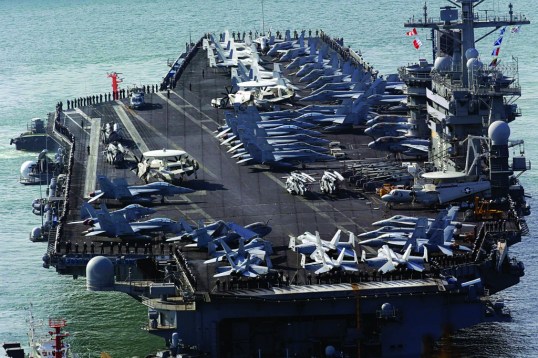
Without battle, Cuba can become the 51st US state, if not at least a protectorate or commonwealth. We can clandestinely destabilize Cuba easily and without force.  Now is the time once again to “Walk softly and carry a big stick.” A few carrier groups and lots of free nationalist dissidents could go a long way to freeing the people of Cuba, and showing them that they, too can enjoy liberty and justice for all.

carrier-2


The big stick part should not be necessary, but it needs to be on full display, both for Cuban defense forces and any foreign government who might want to interfere.

As President Ronald Reagan told Soviet Premier Mikhail Gorbachev to “Tear down this wall,” separating East and West Germany, so too, should Donald Trump insist on Raul Castro or his successor, to “Let the Cuban people go!”

Balance of Power 2016

Back in the late 1980’s there was a computer simulation game called “Balance of Power” that pitched the Evil Empire of the Soviet Union against the global super power of the United States in a geopolitical contest. The game assumed only two influential countries, a bipolar reality.

balance_of_power_coverart

The game was direct; if either country went too far in attempting to influence other countries, DEFCON 4 would be declared and the game would end in global thermonuclear war. Both players would lose, just like the ultimate scenario of the Star Wars missile defense system-inspiring movie, “War Games.”

The algorithms of the game however,  did not even allow for the chance for, East and West Germany to be reunited, or for the Soviet block to dissolve. It was a major flaw in the game, but reflected the bipolar thinking of the time.

In reality, and in hind-sight, it has always been a multi-polar geopolitical scene. Back then there were U.S. satellites and Soviet satellites, but many of our allies were influencers of their own. Today, these influencers make up the complex multi-polar geopolitical reality.

The European Union, OPEC, NATO, China, North Korea, South American countries, African countries, Southeast and Southwest Asia, Australia and the various factions of the Islamic State and al Qaeda, all have regional and/or global influence through words and/or deeds that affect how the U.S. and Russia are perceived.

In the late 1980’s and early 1990’s the world moved away from Soviet influence and towards American democracy; multi-polar players gained strength and influence. As we moved through the Clinton years however, our standing in the world diminished. It strengthened again during the Bush years, but then for the past eight years or so we have been driven towards the abyss of geopolitical enigma.

The U.S. is no longer viewed as the single super power, even though on paper we still are. If we are not willing to use our strength, the sharks that smell blood in the water will come nibbling, and if nothing happens to them on the nibble they will take bites.

Lies about a “red line in the sand” (Syria), blowing off a status of forces agreement (Iraq), neglecting security at embassies and consulates (Benghazi), declaring the Global War on Terror “over” (Afghanistan), trading an Army deserter (Bowe Bergdahl) for five high level Taliban leaders, releasing high threat detainees from the U.S. military detention facility at Guantanamo Bay, Cuba, normalizing relations with Cuba, all combine to let our enemies and non-friends know we are unwilling and unable to respond.

Even seeming innocuous incidents, such as Iranian aggression in the Persian Gulf, and Russian planes buzzing our ships in the Baltic Sea prove to those who would do us harm that we are impotent.

obamabows

Bites will turn into a feeding frenzy – see current Syria and Iraq.

Russia has warned the U.S. that attacks on Assad’s Syrian forces will bring a response from them; ball in U.S. court.

What will the U.S. do with the ball? Pass it to the next president? Shoot it at the basket (Russians) and try to score (put them in their place)? Or will we throw it away (ignore the threat) and then suffer the consequences of leaving our fate up to others who decidedly do NOT have our best interests at heart?

One strategy could be to withdrawal completely from Syria, not as a retreat, but as a retrograde maneuver in order to let Russia have Syria all by itself. Russia would have to support Syria and rebuild the decimated country, or risk being expelled or dragged into a further quagmire. The U.S. would not benefit from “victory” in Syria, as there is no consolidated or legitimate force opposing Assad. We would be accused, and rightly so, of neocolonialism and occupation of a sovereign foreign nation.

Let Putin deal with Assad, he can have him, and the headaches and costs associated with meddling in a civil war. Putin would have to do the right thing by Syrian citizens or risk even more international disdain.

The U.S. finally got it right with the surge in Iraq, coupled with aggressive disruption of the human elements supporting al Qaeda. Many daily and nightly clandestine missions in that country, combined with the embedded U.S. soldier approach in the towns, cities and villages of Iraq, worked like magic.

petraeus-rashid-6-30

The bad guys became the hunted. As more of them were captured and interrogated, more information was gleaned that helped us shut them down. Ground was taken, held and rebuilt. Instead of double-agents infiltrating U.S. and Iraqi operations, we infiltrated and killed al Qaeda from within.

The current strategy of droning leaders, bombing small targets, using only Special Forces, and releasing operatives to fight again is ineffective at best and suicidal at worst. Killing one’s and two’s with a weapons system that more often than not also kills innocent civilians is counterproductive. Enemy leaders are replaced in a heartbeat; detainees from Gitmo who become leaders of enemy organizations allows our enemies an advantage we can’t overcome with drones, bombs and hyperbole.

We are in a most vulnerable position now with less than 30 days left before a presidential election that promises either a sea change in American geopolitical strategy or guaranteed uncertainty.

You know the saying that one should do something questionable without asking permission first because it’s better to be scolded than to be told “No?” Our enemies are not asking our permission. They are being as aggressive as they need to be in order to take what they want and then telling us to bugger off if we get too curious.

It is the worst possible scenario come to life.

In war there is less right vs. wrong and more survival, and those who survive live to fight another day.

us-military-might

At this point in the Global War on Terror – a multi-polar geopolitical morass – we must begin to flex our muscles and play it smart as the one true super power, or the feeding frenzy will take hold and the balance of power will shift solidly to the left.

The Global War on Terror is Here

The recent series of terror events were not perpetrated by “lone wolves” or individual lunatics; they were perpetrated by the enemy in a war, on a battlefield that is our home.

These were not battles so much as probing actions. The enemy, radical Islamist terrorists know we have thousands of cameras and a blood lusting media that will cover their actions in toto.

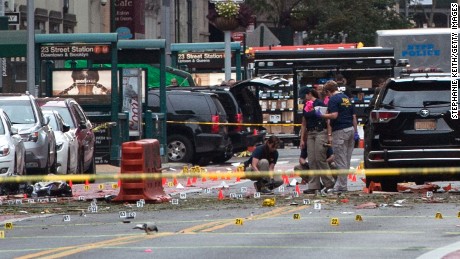
The enemy knows we will respond, and now they know how we will respond, to Ft. Hood, to Chattanooga, to San Bernardino, to Orlando, and now to Chelsea in New York City and to a train station Linden, New Jersey.

A vigil is seen near the site of the shooting at the Pulse gay night club in Orlando

A vigil is seen near the site of the shooting at the Pulse gay night club in Orlando, Florida, June 13, 2016. REUTERS/Jim Young

The enemy is learning about us. They are not in a hurry. They are willing to be plodding, deliberate and insidious.They have no timetable for their goals. They do not think linearly, they think cyclically.

The Caliphate is a century’s old concept, and what’s going on now is just another spot on the spinning globe of terror, not a start or a stop.

Think of radical Islam in terms of a circle. No beginning, no end; a constant continuum.

Radical Islamists care only about the edicts of Sharia law, the killing of infidels, the conquering of Jews, Christians and non-believers. They will not stop, they will not flinch. They are totally committed, mind, body and spirit.

Forgive the analogy for non-Trekkers, but the Islamic State and its followers and off-shoots are like the Borg; automatonic, they are part human, part machine.

They are human, in the sense only that they bleed, eat, sleep and perform other natural human behaviors, from pro-creating to violence. They are machine, in the sense that any connection to rational, compassionate, loving or logical behavior has been severed.

We are left with a poor resemblance of a true human being.

The Borg’s sole purpose in life is to attain perfection through assimilation. The Borg are drones, subservient to the Borg Queen and programmed to defend her at all costs. They share a collective consciousness and can communicate almost telepathically.

Radical Islamists share the oneness of the Koran, specifically the brutality of Sharia law. Radical Islamists believe they are at war with us and anyone who does not think and behave as they do, so, like the Borg, they seek to assimilate the infidels or kill them.

Watch old episodes of Star Trek, especially The Next Generation, or the Star Trek film First Contactand you will see chilling similarities between radical Islamists and the Borg.

Even though the most recently apprehended terrorist, Ahmad Khan Rahami, a naturalized American born in Afghanistan, was part of a family owned business, First American Fried Chicken in Elizabeth, NJ, he had been radicalized by nefarious forces in Islam.

first-american-fried-chicken

Rahami grew up American, but succumbed to the call of the Caliphate and to the glory of the afterlife.

Rahami is a soldier, a programmed cybernetic killer, whose motivation and that of his comrades is irrelevant. The only important thing to know about him and all Islamists is that they want us dead.

Until all Islamists are dead or no longer have the means or will to kill us we must defend ourselves.

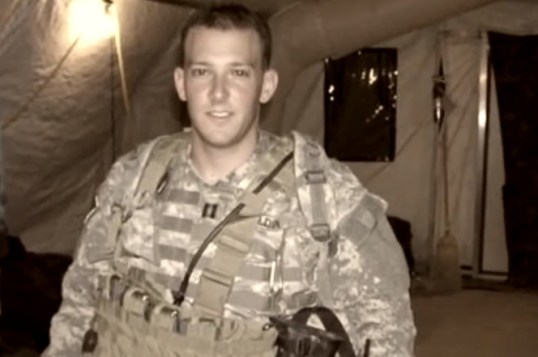
I don’t own a weapon, although I carried one in the Army for 22 years, including in a combat zone. I respect and will defend the right of Americans to keep and bear arms to my last dying breath.

Now I am thinking, since the Global War on Terror is here, how will I defend my family from radical Islamic terror? What if these probing actions become a street-to-street or house-to-house assault? How would I protect my family?

How would I protect my family during an innocent birthday trip to New York City for my daughter?

For years after 9/11 every time I saw a passenger plane in the sky I would look up with a pinch in my stomach. “Will this one crash into a building, too?”

Now, when walking the streets of Manhattan, where I worked for 8 ½ years, mostly in the Chelsea neighborhood, what will I feel when I see a trash bin full of trash? Normally at every corner, these items are a necessity. How can they be managed safely?

Is terrorism working? How can we stop it/them? Who will stop it/them? Do we have to do it ourselves, and if so, how?

Someone in authority needs to come up with some answers and fast, or the third world we see on TV will be us.

chelsea-explosion-0918-large-169

I am the author of “Saving Grace at Guantanamo Bay: A Memoir of a Citizen Warrior,” and three times mobilized U.S. Army Reserve Major (Retired). Author web page: http://sbpra.com/montgomeryjgranger/ Twitter @mjgranger1

Lee Zeldin, Keeping American’s Safe

“In today’s world, it is so important that we do everything that we can to keep Americans safe.” Lee Zeldin (R-NY-1) is a family man, veteran, and dedicated citizen. In his work as U.S. Representative for New York’s First Congressional District on Long Island, he prioritizes the safety of his constituents and all Americans.

When it seems like the current President and his administration are more concerned with a kinder, gentler and even apologetic global image for the United States, Lee Zeldin believes in keeping America strong and safe.

That’s why last December, Lee introduced the Protect America Act (H.R. 4237), which will “prevent terrorists from being able to purchase firearms or explosives while protecting the due process rights of law abiding citizens.”

in-uniform

The bill’s mantle is that terrorists should “absolutely not” not be able to purchase firearms or explosives. The bill goes beyond that to also protect the Second Amendment rights of Americans.

In denying a gun purchase, Zeldin believes the burden of proof should be on the Federal government to show probable cause. Citizens have a constitutionally supported right to due process, and the bill protects that right within the context of purchasing fire arms.

“Additionally, citizens deserve their right to notice, counsel and a hearing related to the presentation of this evidence justifying the denial of the purchase [of a firearm],” according to Zeldin.

The bill also addresses the need for diligent vetting and updating of terrorist watch lists to “remove all erroneous entries” on such lists. Americans deserve protection from both potential attacks and from being falsely identified as a potential threat.

Shortly after the terrorist attack on innocent Americans at a night club in Orlando, Fla., Lee Zeldin made a statement that hit home and demonstrated his commitment to protecting Americans:

orlando

“The handgun and Sig Sauer rifle used in this terrorist attack did not march itself into the nightclub and discharge itself. There was a shooter who was a radicalized Islamic terrorist pledging allegiance to ISIS, who violently hated the LGBT community and yelled “Allahu Akbar” while killing 49 innocent Americans. There is a whole lot more going on here beyond the gun control debate and attempts to narrow this issue so glaringly is alienating the rest of our country who understand the bigger picture.”

Guns aren’t the problem; unrestricted access to guns by terrorists is part of the problem. Denying reasonable access to lawful American citizens is not a solution.

The Protect America Act is a solution.

If concerned Americans contacted their Representatives and urged them to support the bill more lives could be saved. A deterrent today is always better than a reaction too late.

Gen. George S. Patton, Jr., said, “A good plan, violently executed now, is better than a perfect plan next week.”

H.R. 4237 doesn’t to pretend to fix everything that could be better about terrorists and guns in America, but it would bring us that much closer to the perfect plan.

“In order to form a more perfect Union,” from the preamble of the U.S. Constitution, means that we as Americans strive for perfection in everything we do, while recognizing that we are not perfect.

The Judeo/Christian ethic of following the Ten Commandments and the Golden Rule help guide our decision making and form the basis of our values. These principles also guided our founders and offer illumination on our struggles today.

Lee Zeldin appreciates these American values, which is why he introduced the Protect America Act. He walks-the-walk as an American soldier, is a loving husband and father, and keeps his faith as a practicing religious American.

family-man

Just past the 15th anniversary of the terrorist attacks of 9/11, are we any safer today than we were on September 12, 2001?

Supporting Lee Zeldin for Congress and encouraging your Congressmen and women to support the Protect America Act would be a big step in keeping all Americans safer in a stronger U.S.A.


Montgomery Granger is a veteran, retired U.S. Army major, and author of “Saving Grace at Guantanamo Bay: A Memoir of a Citizen Warrior.

Abu Zubaydah: Obama’s Crucible

If the current review board approves Abu Zubaydah for release, President Barack Hussein Obama will have won his struggle to close the U.S. detention facility at Guantanamo Bay, Cuba.

Even Khalid Sheik Mohammad is not as valuable as Zubaydah.

If Zubaydah is released from Gitmo then the only rationale that makes sense is that the President considers all detainees to be victims and should be released.

If this is the case then the enemy has won and the Global War on Terror is over once and for all. The Obama administration’s philosophy of fighting alomst-wars with bombs, drones and Special Forces will continue only as “overseas contingency operations.”

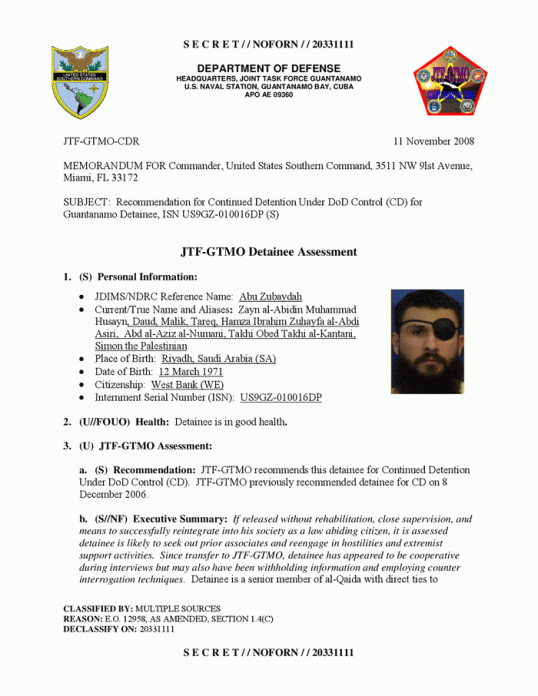
When one reads the Guantanamo Docket on Zubaydah chills run down the spine.

The docket for Zubaydah, easily accessible online via the New York Times, is 14 pages long, and documents his background. Captured in early 2002 and then transferred into U.S. custody, Zubaydah was sent to Gitmo in 2006 after intense interrogation by the CIA. The docket was published in November 2008 and carries the classification label of “SECRET.”

Abu Zubaydah.1

According to the documents, Zubaydah was “equal to and not subordinate to UBL (Usama bin Laden),” founder and leader of al Qaeda. Zubaydah was a parallel associate who coordinated activities and support operations, including planning and training for various terrorist activities, some successful, some failed.

Among other things, Zubaydah is a master forger and ran a fake and stolen document clearing house from which al Qaeda operatives could obtain myriad forged documents. Everything from false claims of torture to passports.

Zubaydah’s connections, associates and comrades ran the gamut and is a virtual who’s who in the world of terrorists, listed in his docket. From dirty bomb plots to planning the bombing of U.S. Embassies, Zubaydah always seemed to be in the thick of it.

A Palestinian by heritage, born and raised in Saudi Arabia, Zubaydah wished to carry out attacks on Israel, a sticking point between himself and Usama bin Laden, who favored American targets.

According to documents revealed in the Senate Select Committee on Intelligence, CIA officers concluded that Zubaydah, “Should remain incommunicado for the remainder of his life.”

Worst of the worst? Understatement.

Obama’s challenge to detractors will be: if he can let the absolute WORST detainee go, why not all the rest? He’s going for a grand slam home run, a 99 yard Hail Mary pass and the Triple Crown all at once.

If Obama fails he will probably blame it on former President George W. Bush for picking a fight with the bad guys in the first place.

If he wins, he gains his legacy, and he is vindicated. One big victory will erase all the other blunders, mistakes and missteps included, all in an instant. Why not go for the hardest point on the dice? Making the roll would wash away the stink that’s been covering him for nearly eight long years since he made the promise to close Gitmo in the first year of his presidency.

This president is beyond desperate. He simply MUST make good on his word and Zubaydah, his crucible, is his key to victory.

The question is, will Congress continue booing from the peanut gallery or will they actually do something to stop this insanity?

Gitmo is not playing a top roll in presidential politics, and the recent release of 15 high risk detainees to the UAE caused only a ripple in the mainstream media’s white wash of the released Gitmo terrorist threat, even though 30 percent of released Gitmo detainees return to terrorism.

Presidential candidate Donald Trump has said he would “fill up” Gitmo if elected in November. His position is one of the sheep dog, the protector. Hillary Clinton, if elected, would probably continue the current policy of emptying Gitmo to the point of critical mass, hoping to close it on the basis of economics. Is it really too expensive to protect the safety and security of the American People? She is the wolf in sheep’s clothing.

Lacking center stage or any real attention from the mass media, Gitmo remains an enigma, a mysterious and notorious singularity in a sea of chaotic confusion.

From my view, Gitmo is the finest military detention facility on earth. It is a small but necessary piece in the big puzzle of how to keep America and Americans safe in the Global War on Terror. Closing Gitmo would give great momentum and strength to our enemies, and betray the promise of doing whatever it takes to protect the United States and its citizens from the scourge of terrorism.

I am the author of “Saving Grace at Guantanamo Bay: A Memoir of a Citizen Warrior,” and three times mobilized U.S. Army Reserve Major (Retired). Author web page: http://sbpra.com/montgomeryjgranger/ Twitter @mjgranger1

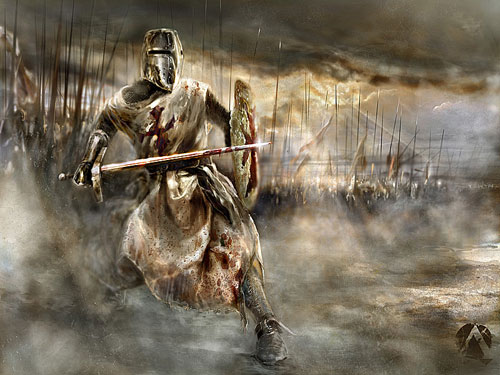
Answering the Jihad: Did Someone Say ‘Crusade’?

crusader

What’s the difference between the Crusades, the Barbary Wars and the Global War on Terror?

As far as jihadist Islamists are concerned absolutely nothing.

These conflicts were and are simply an excuse to murder anyone who is not like them. Like an obsessed teenager high on caffeine and sugar playing marathon rounds of Mortal Kombat, Islamists murder for sheer pleasure, the terror effect is just a pleasant byproduct for them.

Islamists have used the Crusades (four major armed Christian pilgrimages to the Holy Land from 1095-1289) as a recruiting tool with low-information Muslims, who are easily radicalized, especially if they are of meager means and background. Improving one’s standard of living or social status through joining radical terrorist movements is tough to counter if we are not in a position to do so, and are in fact running away from the fight.

Even Pope Francis seems to be calling for a Fifth Crusade, saying in response to the crisis in Iraq, over which he said he was “dismayed” and in “disbelief,” that there was a need for “a professional, well-equipped army” because “the situation is going from bad to worse.”

But the United States can’t seem to get out of it’s own way with regard to foreign policy chaos. It’s as if we’re drunken gamblers betting our shirts after losing all our money, watch, shoes, boat and home!

Politically, all the death and destruction is bad for business in the Obama camp, especially after seemingly endless foreign policy mistakes, from red lines in the sand to putting five big time Taliban bad guys back in the fight in trade for a suspected U.S. Army deserter. Trying to figure out the thinking behind these and other incredible missteps drives one to distraction!

After the bloodshed in Orlando, with over one hundred injured including at least 50 dead, the Islamic State has claimed responsibility. Their crusade continues.

If an enemy is bold enough to shoot high quality video of the beheading of an American journalist (Daniel Pearl by Khalid Sheikh Mohammed, February 2002; and James Foley, August 2014) in the Middle East then they are able to do so in the streets of America, and have now done so.

Radical Muslims from around the world have answered the clarion call to join the Islamic State in their caliphate, including those from the United States, Canada, Europe, Russia, Asia and parts of Africa.

What will be our answer now?

For too long we have resisted the fact that Islamists are at war with us. We have responded with force and resolve during certain times and then responded with our heads in the sand at other times. The result? Nightclub bloodbaths in American cities.

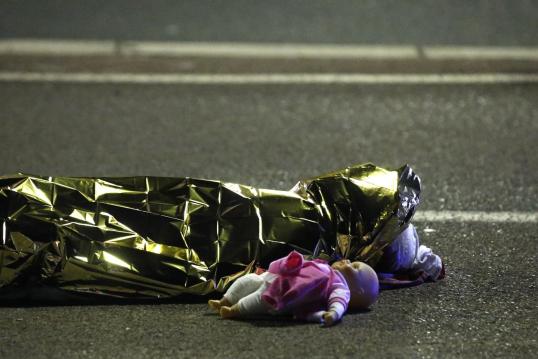
And now? Nearly 100 dead innocents on the streets of Nice, France. 130 dead in Paris. Europe is on fire with “migrating” jihadist’s. “Home grown” or refugee, student visa or immigrant. Islamists who believe in Sharia Law are incompatible with the Judeo/Christian ethic or even socialist. Muslim theocracy is the antithesis of democracy.

Nice.1

American patriot Thomas Paine once said:

“Those who expect to reap the blessings of freedom, must . . . undergo the fatigue of supporting it.”

That “fatigue” has weighed heavily on us, especially on the victims of terror and on our military community, who have borne the brunt of the burden.

President Barack Obama’s and his cabinet’s lack of military background are handicapping their decision-making regarding military action to protect and defend the interests of the United States. Barack Obama has even been recently exposed for not meeting even once with his Defense Intelligence Chief, Lt. Gen. Michael T. Flynn.

The modus operandi of this naïve group is to grossly politicize every single crisis after putting their proverbial licked finger in the air to determine the direction of the politically correct wind before making a statement or tenuous commitment.

The result is a weakened and vulnerable United States at the mercy of barbarians. But how we got here is not nearly as important as where we’re going and how?

It is imperative that we begin and then sustain a planned and committed offensive against the tyranny of Islamists. There should be no safe haven, no quarter given, and no mercy for the members of the murderous caliphate. But if we call it a “Crusade” what could possibly be the down side? It might even inspire a new generation of committed anti-Islamists.

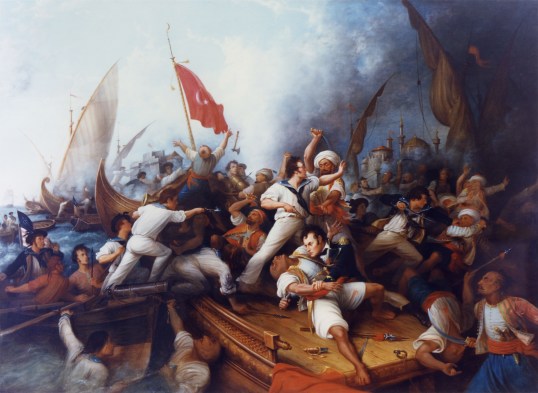
In the early days of the 19th century this country battled and then defeated a former Islamist caliphate in the Barbary Wars. Barbary pirates of Northern Africa demanded tribute for captured merchant and military ships and the merchants, sailors and Marines on them. President Thomas Jefferson refused to comply, as did President James Madison. Instead, the United States sent warships and Marines to rescue our ships and personnel, and to destroy the pirates, and their will and means to terrorize us on the high seas.

Decatur_Boarding_the_Tripolitan_Gunboat

In the end, our resolve and resources won the day, and after our example was set, European countries followed suit, building and then deploying some of the world’s fastest and most powerful ships at the time in a combined effort to suppress the pirates.

For Islamists to be defeated, once and for all, a combined effort is necessary. But this combined effort needs a leader.

If not us, who? If not now, when?

At home we  need better vetting and/or a moratorium on immigrant and other Muslims entering the country. It sounds xenophobic, but enough is enough. We’re not being killed by little old lady Catholics, Protestants or Jews. We’re being targeted and killed by Muslim men (mostly). Enough already!

Deploying the 82nd Airborne Division and United State Marines to the Middle East may seem a drastic and painful choice, but we must stabilize the area of Islamist infiltration with a physical presence and then invoke a Middle East Marshall Plan when the dust settles and all Islamists are either dead, or no longer have the means or will to kill us.

Helping to rebuild the infrastructure and self-esteem of people exploited and terrorized by Islamists will win hearts and minds, as it did against Nazi Germany and Imperial Japan.

We still have troops in countries we defeated in World War II over 70 years after the end of that war. These countries are now among the most peaceful and prosperous in the world, not in spite of our presence, but because of it.

Peace and prosperity should be enticing rewards for those who currently choose violence and destruction. The alternative we are living now is unacceptable, the price already paid by our military members and their families and loved ones too great.

So, if our enemies call it a Crusade, why not at this point fulfill their dreams of 72 virgins and play along? Nothing else is working.

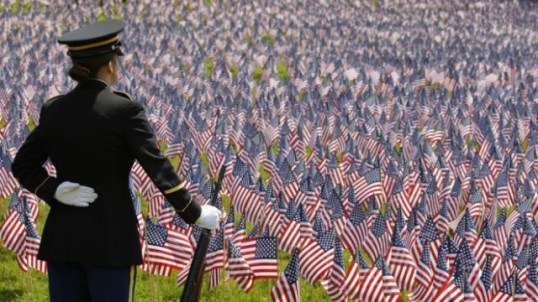
While the President Honors the Enemy, Americans Honor Americans

Memorial Day.1

President Barack Obama has visited the Peace Memorial Park at Hiroshima, but Japanese Prime Minister Shinzo Abe has no intention of reciprocating with a visit to Pearl Harbor, Hawaii.

The U.S. president said he visited Hiroshima to “honor all WWII dead.” All, Mr. President? Kamikaze’s? Nazi’s? Pearl Harbor bombers? Bataan Death March Imperial Japanese? Murderous SS troops who massacred defenseless American POW’s? All Mr. President?

On the 40th anniversary of the bombing of Hiroshima, President Ronald Reagan said: “We must never forget what nuclear weapons wrought upon Hiroshima and Nagasaki, yet we must also remain mindful that our maintenance of a strong nuclear deterrent has for four decades ensured the security of the United States and the freedom of our allies in Asia and Europe.”

Nearly 22 years ago, Emperor Akihito visited a war dead cemetery just a few miles from Pearl Harbor on a stopover on his way to North America. His original itinerary included a visit to the memorial at the site of the capsized U.S.S. Arizona, still entombing 1,100 sailors, but protests from right wing Japanese altered his plans. The right wingers claimed Japan was provoked by a United States’ embargo at the time.

Memorial Day.3

No sitting American president should ever visit Hiroshima or Nagasaki, until or unless a sitting Japanese Prime Minister or Emperor visits Pearl Harbor. Apologies aside, showing up is an act of support and sympathy.

Embargo or not, a true act of war such as the killing of 2,400 people at dawn on a Sunday should rate a full and sincere apology. If not, stay far away from even the slightest perception of sympathy for those who caused over 100,000 U.S. casualties in the Pacific after the sneak attack on December 7, 1941.

Absent the nuclear attacks by the U.S. on Imperial Japan in the summer of 1945 it is estimated that over one million Americans would have lost their lives fighting conventionally to subdue the Japanese. The Imperial Japanese had already mobilized women and children in its defense.

Memorial Day.4

In war, right and wrong can be overcome by what is necessary. Survival is necessary.

Apologies without sincere repentance are mere political gestures. Obama may have gotten away with both. After laying a wreath at the Peace Park and “honoring all war dead,” he lamented nuclear weapons, the very things that have secured relative peace and prosperity in Europe and Japan for over 70 years.

The President’s biggest mistakes have been withdrawing from victories and stability, only to find himself in a quagmire not seen since the Vietnam War. Iraq and Afghanistan were pacified and peaceful before draw downs and withdrawals were ordered by the President.

Now we find ourselves still losing heroes in pointless and ineffective military missions that dishonor theirs and the lives and ground lost previously.

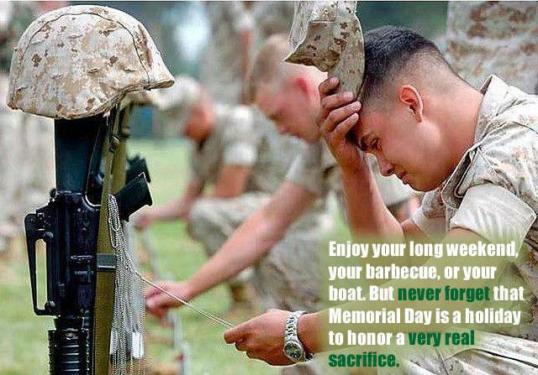
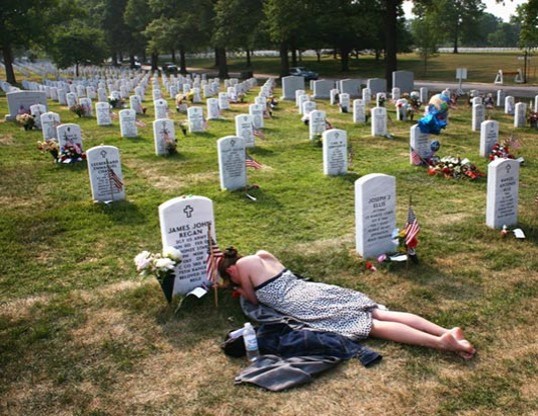
All WWII dead, Mr. President? On this Memorial Day weekend? Not on your life.


One Nation, Under God, Except in Florida

TOSHIBA Exif JPEG

TOSHIBA Exif JPEG

Atheists and liberal anti-Christians are at it again, this time successfully supporting legislation in the Sunshine State to make it unlawful to force a student in the public schools there to stand at attention or say the Pledge of Allegiance.

A previous law required only that students stand at attention during the pledge if they didn’t want to recite it. Now they may sit.

It’s a shame that every school in Florida can’t have a wounded veteran appear in a wheel chair in front of the students and then tell them about how he or she CANNOT stand to honor the flag that represents the reason they sacrificed their ABILITY to stand for it.

It’s a shame that legislators in Florida no longer hold dear the values that created this nation and made it free in the first place.

Communists and socialists and atheists will tell you it’s bad to swear oaths and make pledges, but in an instant would turn around and have you promise your individuality and creativity away with state sponsored dogma limiting your ambitions and directing your energies to the “common” good.

No individuality or capitalism in their small mental world of what’s good and what’s bad. That translates to “no incentive” to excel or invent a better way.

I remember a friend in elementary school, Danny, who would not say the pledge. His religion forbade him from celebrating or pledging allegiance to anything. We respected and liked Danny, who would just stay home rather than be exposed to holiday parties in class. No Christmas or Halloween or Easter. We felt sorry for him, too.

What’s more than just passing legislation that says students no longer have to stand for the pledge, atheist groups are threatening lawsuits against any person who violates the law. Every student has now become an informant for the overseers: another Communist ploy that conjures memories of the child murderers of the Cambodian Khmer Rouge who would round up teachers and kill them.

I had a teacher colleague of mine from my New York City teaching days get a one year suspension for refusing to take down a poster with the Ten Commandments on it. It was in his classroom along with posters with the religious edicts from other religions on them.

Ten Commandments

Back then we had many known and even proud Communist Party U.S.A. members among the faculty. C.P.U.S.A. headquarters was just a few blocks away on 23rd Street, Manhattan, disguised as a bookshop. They ratted out my friend and forced the principal to write him up and then get him suspended.

My friend argued that since he had come to the portion of his ESL (English as a Second Language) history class where they discussed world religions that it would be OK to post the Ten Commandments. Not so fast, the atheists said! And they got their way.

Of course the charges had nothing to do with the myth of “separation of church and state,” but everything to do with insubordination, one of the few deadly sins in the tenured teacher world. My friend was eventually fired.

The myth of “separation of church and state” is perpetuated by Pagan, utilitarian, humanist atheists and liberal progressives. Too many descriptors? Too few probably, but operatively, Pagans do whatever feels good; utilitarian’s believe that if it’s useful to them it is good; and humanists feel that they should be able to do whatever they want as long as it doesn’t hurt another politically correct minion (it’s OK to hurt those who believe in the Judeo/Christian ethic).

Contrast that with Judeo/Christians and most other law abiding, respectful Americans, practicing religions or not, who believe in the Golden Rule, Life, Liberty and the Pursuit of Happiness.

Here you have the classic dichotomy that represents our current Great Cultural Struggle.

Social engineering abounds in these troubled times with gays openly serving in the military, transgenders pooping and showering wherever they please, legalized gay marriage, and the nation’s first openly gay Secretary of the Army. It’s an end to “live and let live;” it’s open season on the Judeo/Christian values that founded and perpetuated our society.

The Constitution provides the answer to the question of whether or not there is such a thing as the separation of church and state. You have the Establishment Clause:  Congress shall make no law respecting the establishment of religion – which means no state sponsored religion forced on the People. The Puritans and other original colonists from Old World Europe left to establish religious freedom, not to make a theocracy.

And then you have the Free Expression Clause: Congress shall make no law . . . prohibiting the free expression [of religion]. Nowhere does the Constitution say anything about separation of church and state.

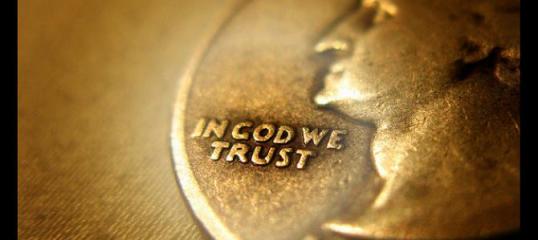
ingodwetrust

In fact, above every Federal Court bench “In God We Trust” can be found in gold shiny letters. On our currency you’ll find the same, on coin and paper. A taxpayer-funded chaplain recites an invocation in Congress before each session. “One nation, under God,” is in our Pledge.

We are a nation of believers. The Pledge and the “Star Spangled Banner,” our national anthem, are tools of our patriotism. They help to bring us together in a country where the founders wanted government out of our religion, but NEVER intended for religion to be out of our government.

According to our founding document there are many references to a deity. Many founders were religious if not Christian. And those who weren’t respected those who were. They wanted a free nation, not one in which the non-religious set upon the religious with pen, paper and intimidation.

I say, shame on the Florida legislature, shame on the atheists bullying educators and children, and shame on the United States of America for allowing it to happen. What’s next, banning the crucifixes on Christian churches?

It would be wonderful if Florida legislator’s would reverse their decision, but like the Boy Scouts of America, who changed their philosophy of not allowing openly gay boys or leaders to join because they could no longer bear the financial burden of fighting LGBT zealots in court, I fear the legislators in Florida have succumbed to the same foul sources of anti-establishment fanaticism.

I hope and pray that the youth of Florida rise up and stand for and then say the Pledge. And while they do, looking at the Stars and Stripes, remember those who fought and/or died for the rights of others not to say or stand for it.