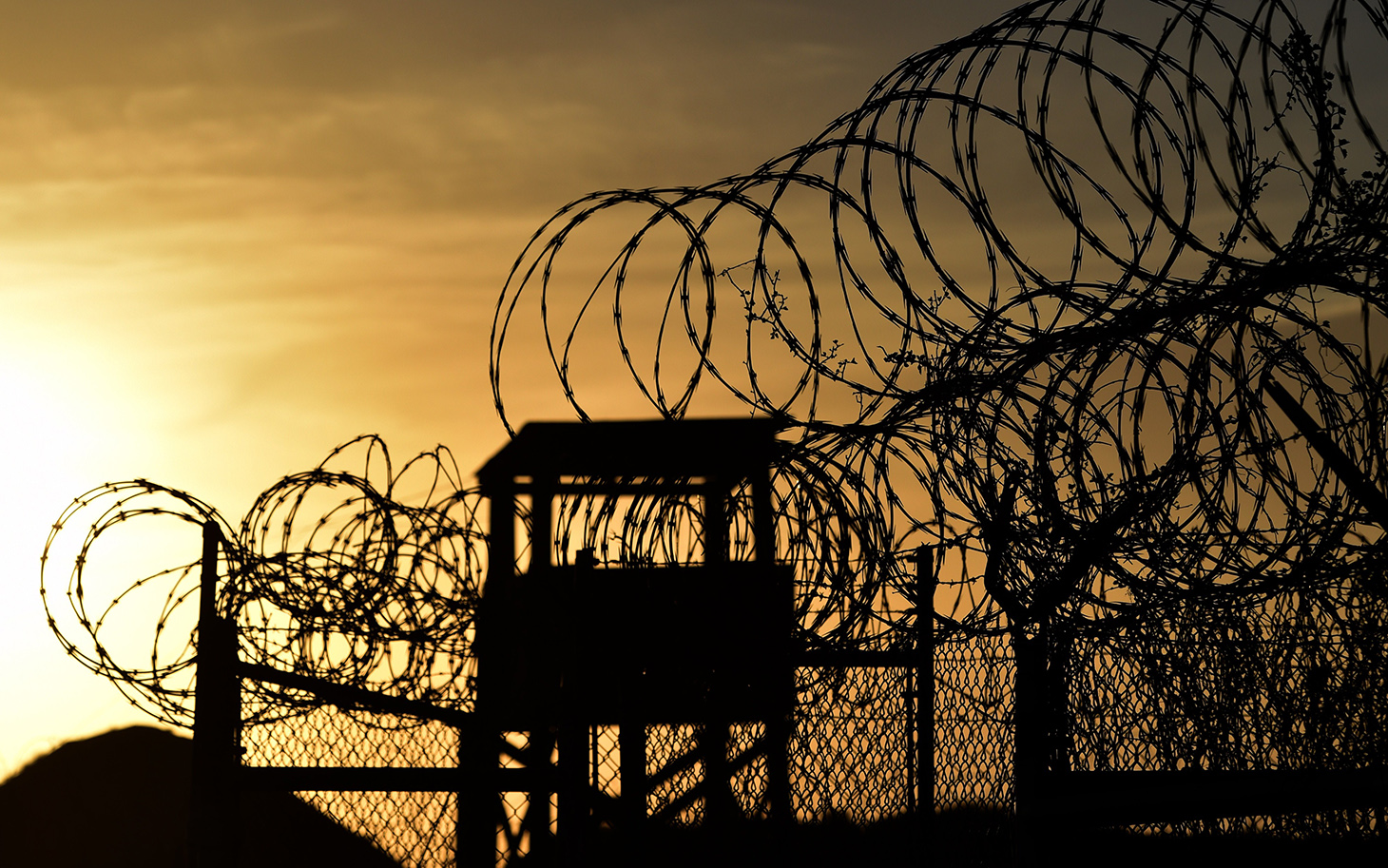
This photo made during an escorted visit and reviewed by the US military, shows the razor wire-topped fence and a watch tower at the abandoned “Camp X-Ray” detention facility at the US Naval Station in Guantanamo Bay, Cuba, April 9, 2014. AFP PHOTO/MLADEN ANTONOV (Photo credit should read MLADEN ANTONOV/AFP/Getty Images)
Responsible Statecraft (RS) has memorialized the US military detention facility at Guantanamo Bay, Cuba, in an article by Connor Echols titled, “Why won’t Biden close Gitmo?” Biden won’t close the US military detention facility at Guantanamo Bay, Cuba, because he can’t, Congress won’t let him. Nor would closing Gitmo have a positive effect on the outcome of the Global War on Terror (GWOT).
Author, Connor Echols and RS took the easy way out on Gitmo in their story by regurgitating false narratives conjured over the past 22 years, including erroneous statements from the likes of retired Gen. Michael Lehnert, first commanding general of JTF 160, the governing unit at Gitmo and Camp X-Ray when the mission stood up on January 11, 2002, who said it should be closed.
But when he was there, he coddled unlawful combatant Islamists who wanted to kill us by giving them all candy on a good-bye tour at the end of his tenure. I know because I was there and saw it with my own eyes. Lehnert had no experience with military incarceration, nor was he trained in the discipline that only the Army has experience and expertise in. He was selected for the job because he had run Camp X-Ray in the early 1990’s as commandant of the Haitian boat crisis. Dubious distinction to say the least.
Unfamiliar with the Geneva Conventions, Law of War or US military Enemy Prisoner of War doctrine, Lehnert blindly guided operations at Gitmo in early 2002. If the Army had had sole control over the mission there may have been tribunals, convictions and executions on par with the Nuremberg trials after WWII, where Nazi war criminals were tried before an international commission.
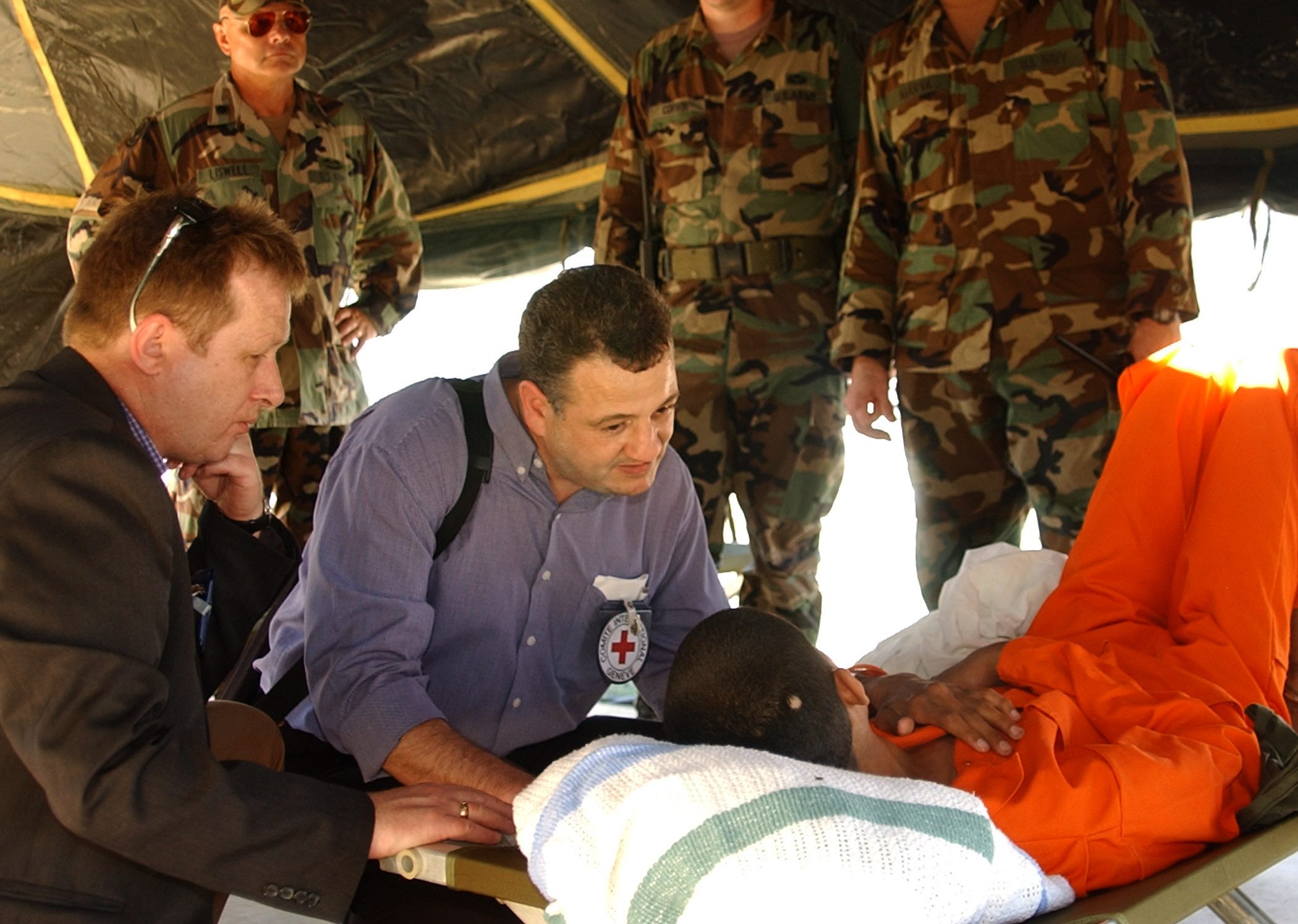
RS claims detainees were treated inhumanely at Gitmo. Nothing could be further from the truth. International Committee of the Red Cross physicians I worked with there and later in Iraq, told me, “No one does [detention operations] better than the US.” Gitmo is the finest military detention facility on earth.
020118-N-6967M-505(Guantanamo Bay, Cuba)
Representatives of the International Red Cross speak with a detainee in Camp X-Ray. Camp X-Ray is the holding facility for detainees held at Naval Base Guantanamo Bay, Cuba, during Operation Enduring Freedom. Official U.S. Navy photo by PH1 (AW) Shane T. McCoy (For Official Use Only)
Tens of thousands of unlawful combatant Islamists who want to kill us were apprehended in the early days of the GWOT, but only just under 800 ever made it to Gitmo (the “worst of the worst,” according to then Secretary of Defense, Donald Rumsfeld), and 745+ have been released. None have been beheaded, executed, blown up, hacked to death, dragged naked and lifeless through the streets, drowned or burned alive. All things our enemies have done to us and/or our allies. There is no moral comparison between Gitmo and how our enemies treat their captives.
Gitmo detainees enjoy free Qurans, prayer rugs/beads, directions to Mecca, white robes, halal and Muslim holy holiday meals, services of US military Muslim chaplains, world class health, dental and vision care, recreation, correspondence, legal representation, library, books, DVDs, TV, video games, sports and more! There is no other place on earth these men could receive such quality treatment.
As for waterboarding and other Enhanced Interrogation Techniques (EIT), they were only “performed on a handful of detainees in order to obtain valuable information that saved many lives,” according to then President George W. Bush, in his memoir, “Decision Points.” EIT were approved and legal and did not meet the internationally accepted definition of torture at the time. Only after the fact did President Obama unilaterally declare EIT torture, outside the accepted definition.
RS claimed the CIA were in charge of these interrogations, and they were also the only US personnel trained in EIT, not the US military or any DoD personnel, according to Secretary of Defense, Don Rumsfeld in his memoir, “Known and Unknown.” The only institutional abuse at Gitmo was by the detainees towards the guards, who regularly sucker punched guards and used their bodily fluids, including urine, feces and semen to “splash” unsuspecting guards, who after a time began to wear face shields when handling detainees.
Although some detainees have spent decades at Gitmo without charge or trial, even lawful combatant POWs may be held in this manner, “until the end of hostilities,” according to the Geneva Conventions or Law of War, two essential documents RS and other Gitmo detractors never mention.
The truth is that according to President Obama’s 2009 Military Commissions Act (MCA), unlawful combatant Islamists accused of war crimes held at Gitmo have virtually the same rights you or I would enjoy in a federal court of law. Unprecedented, this policy undermines the Law of War, which requires those accused of war crimes to be tried under the Uniform Code of Military Justice (UCMJ), under the same standards that US military personnel would be tried.
The MCA is responsible for hamstringing the legal proceedings for the ten detainees accused of war crimes, including those who admit to planning and facilitating the attacks of 9/11 – another subject avoided by RS in their story. Instead of trying to explain these details, RS pretends they don’t exist.
Gitmo is a small piece to the big puzzle of how we win the GWOT. At least 30 percent of all released detainees have returned to the fight, including five Taliban leaders, released by President Obama in a prisoner exchange for one US traitor. Keeping captured suspected war criminals and other dangerous terrorists makes everyone safer and would move us closer to ending global terrorism.
Arbitrary calls to close Gitmo, combined with false narratives, lies and myths about what goes on there do a disservice to American interests in the GWOT. Keeping Gitmo open and “filling it up with bad guys,” as President Trump has promised, give us the best chance for security and victory.
NOTE: MAJ Granger was the ranking US Army Medical Department officer with the Joint Detainee Operations Group, Joint Task Force 160, from FEB-JUN 2002, at Gitmo, and is author of his memoir, “Saving Grace at Guantanamo Bay,” and narrator of the short documentary YouTube film, “Heroes of GITMO,” based on his book.
Recently, a group of Protestant and Anglican church leaders met to discuss Christianity’s role in slavery. The Washington Times covered the event with this story: ‘Churches urged to acknowledge role in racism: Panel holds up mirror to American Christians.’
Balderdash! What a colossal waste of time and resources! No more self-flagellation over slavery!
Most Americans never owned slaves (in fact, less than 5% ever did), and many were always abolitionists, especially those who were members of religious groups, such as the Quakers.
Institutional slavery in the US lasted only 80 years, from 1783 to 1863, the shortest period of time for any country. Crucially, it was not instituted by Americans as a cultural pillar of our country but, rather, was brought to America by the British and Portuguese and sent to the ash heap of our nation’s history only one-third of the way into our 240 years.
Religious leaders should be spending their time preaching the Bible and saving souls, not inventing crises.
In fact, this is simply a stealth attack on the tenets of Christianity and religion in general. It is an attempt to find faults within religion and exploit them. In making religious people acknowledge wrongs they personally had nothing to do with, those who want to change the message of the Church hope to make believers feel bad about themselves and, therefore, capitulate to those who hold victim status.
Interestingly, no Bible references were cited in the Times article. Why?
The Bible contains various passages that address the issue of slavery. It’s important to note that the Bible was written in different historical and cultural contexts, and attitudes toward slavery evolved over time. Here are some key points:
Old Testament (Hebrew Bible):
Slavery was a part of the social structure in ancient times, and the Old Testament acknowledges its existence.
There were regulations regarding the treatment of slaves, emphasizing fair treatment and humane conditions (Exodus 21:2-11, Leviticus 25:39-46).
The Year of Jubilee, occurring every 50 years, was a time when Hebrew slaves were to be set free, and debts were to be forgiven (Leviticus 25:10).
Foreign slaves (mostly non-black) could be owned permanently, and their status was inheritable, but they were also protected by certain laws (Leviticus 25:44-46).
New Testament:
The New Testament doesn’t explicitly condemn slavery, and there are instructions given to slaves and masters (Ephesians 6:5-9, Colossians 3:22-4:1).
In the context of the New Testament, slavery was a common social institution.
The teachings of Jesus emphasize love, compassion, and the equality of all people in the eyes of God.
Interpretation and Context:
Interpretation of these passages varies among different Christian denominations and scholars.
It’s important to approach these texts with an understanding of historical context and cultural differences. Most modern Christian denominations condemn any form of slavery and emphasize the principles of justice, compassion, and equality.
In addition to the passages outlined above, it is interesting to look at the Book of Psalms, which primarily consists of poetic and hymnic passages that express a range of emotions, including praise, lament, and supplication. While Psalms doesn’t explicitly address the issue of slavery in the same way that some other sections of the Bible do, there are passages that touch on themes related to oppression, captivity, and deliverance, all in the context of Jewish/Hebrew/Israelite slaves.
One example is Psalm 137, which is often referred to as the “By the rivers of Babylon” psalm. It reflects the feelings of the Israelites during their captivity in Babylon:
“By the rivers of Babylon, there we sat down and wept, when we remembered Zion. On the willows there we hung up our lyres. For there our captors required of us songs, and our tormentors, mirth, saying, ‘Sing us one of the songs of Zion!’ How shall we sing the Lord’s song in a foreign land?” (Psalm 137:1-4, ESV)
This psalm expresses the deep sorrow and longing for freedom experienced by the Israelites in exile. While it doesn’t specifically mention slavery in the sense of servitude, it reflects the anguish of a people taken captive and removed from their homeland.
In researching his DNA and ancestry, an American black person will typically sooner or later come across a dead end called slavery. Some, however, learn of branches of their ancestral past that circumvent slavery and expose a different or blended experience.
The American black Christian experience blends with a gospel spirituality that included singing songs of freedom in the tradition of the Biblical Psalms. Many of these songs are now part of official hymnals of certain Protestant denominations, such as the Baptists and Methodists.
These include songs like “Swing Low, Sweet Chariot,” “When the Saints Go Marching In,” “Go Down Moses,” “River Jordan,” “Nobody Knows (the Trouble I’ve Seen),” and “Joshua (Fought the Battle of Jericho),” which lament captivity and tell of freedom and heaven.
In the United States, we have one culture, the American culture. And anyone who would divide us is un-American. We are acutely aware of our past, but none of us can change it (though the woke, cancel culture crowd loves to try by changing curriculum, tearing down statues and monuments, and appointing racial overlords to corporate organizational charts). In the end, we are all one people, with one Constitution, one Declaration of Independence, written in English, regardless of race, creed, or color, according to our civil rights law.
None of us need feel guilty about things we had no control over. Those who want you to feel guilty about these things are seeking to control you emotionally and psychologically.
Our energy and focus should be spent on things we can change now, like not supporting proxy wars, closing our border to invaders, cultivating our own energy sources, treating each other with dignity and respect, punishing criminals, rooting out corruption, and creating conditions where all Americans, alive now, can enjoy the foundational principles of this great nation: Life, Liberty and the Pursuit of Happiness.
What would the Messenger of God, Muhammad, say about the current global position of Islam?
He would probably be taken aback, first by the vast expansion of the Muslim faith and then by the wealth and sheer numbers involved, over 2 billion worldwide – almost as many as there are Christians (2.2 billion).
In 2023, almost 50 countries are majority Muslim. At the time of the prophet’s death, in 632 CE (equivalent to 10-11 BC), there were just under ten countries or territories under Islamic rule, all in the Arabian Peninsula. An accurate calculation of the Muslim population at that time cannot be made due to the lack of documentation and census data.
It was only after Muhammad’s death that vast conquests and expansion took place. At its height, Islam claimed 29 countries or territories, including major portions of Asia, Africa, and Europe, in the 8th and 9th centuries before the retribution of the Crusades began in the late 9th century (lasting through the earliest part of the 13th century).
The Crusades did not lead to any significant lasting Christian presence in the Middle East but did take back and keep certain areas of southern Europe, including Spain, France, and Italy.
Muhammad today would be pleased and proud to know Islam’s expansion had reached every settled continent and had grown to include every race, creed, color, and socioeconomic background. He would be thrilled to also know that schools, called Madrasas, exist to teach children his Sharia Law, five pillars of faith, taqiyya (the moral absolution of lying to the “kafir” or “nonbelievers,” or “deceivers”), and “dhimmitude.”
“Dhimmitude,” or the “dhimma system” in the context of Islamic history, is a system involving the treatment of non-Muslim communities, particularly “People of the Book” (Jews and Christians) living in Muslim-majority lands. Dhimmitude was characterized by a set of rules and restrictions, as well as the payment of a special tax called the jizya, in exchange for protection and the ability to maintain their religious practices.
Historically, under the dhimma system, non-Muslims were given a choice between several options, which generally included:
Conversion to Islam: Non-Muslims could choose to convert to Islam, thereby becoming equal to Muslim citizens in terms of legal and social rights.
Payment of Jizya: Those who preferred to remain non-Muslims were required to pay the jizya tax, which symbolized their submission to and protection by the Muslim state. The jizya would increase over time to the point where cash-poor non-Muslims would have to pay in collateral – land, property, livestock, etc. until they were penniless and destitute. This was possible because the Muslim faith requires theocracy – the joining of government and religion (which is diametrically opposed to the US Constitution).
Adherence to Dhimmi Regulations: Non-Muslims were expected to adhere to a set of regulations governing their behavior, dress, and religious practices. They were also subject to various social and legal restrictions.
Protection: In return for the jizya and adherence to the dhimma regulations, non-Muslims were entitled to the protection of the Muslim state, ensuring their safety from external threats.
Death, Enslavement, Rape, Marriage, Concubine: If, however, a non-Muslim community chose not to convert to Islam or pay jizya, the Islamist hoards would invade, kill or enslave the men, enslave, rape and/or marry the women (turning them into concubines), and kill, enslave, marry or concubine the children—all according to Sharia Law.
It’s important to note that the dhimma system varied over time and across different regions, and not all non-Muslim communities experienced it in the same way. Additionally, the dhimma system has largely been a historical practice, and contemporary civil Islamic societies do not necessarily employ this system – at least overtly. However, caliphate Islamist societies and some Islamist terror states do continue to employ this barbaric and brutal practice.
In real-time, however, we are seeing the hidden modern dhimma hoards raise their savage heads through the uprisings against the Israeli incursion into Gaza (which, we must remember, came after Islamist Hamas terrorists massacred 1,400 innocent Israeli men, women, children, elderly, infirm, pregnant women, and babies).
The Islamist rallying cry, “From the river to the sea,” is being characterized by Islamist apologists such as US House of Representatives Member Rashida Tlaib as “an aspirational call for freedom, human rights, and peaceful coexistence.” But it is, in fact, a call for genocide, as it refers to the Hamas charter requirement that Israel will only exist “until Islam will obliterate it.” In other words, all Jews living between the Jordan River and the Mediterranean Sea (that is, in the state of Israel) are to be obliterated.
Make no mistake, the Islamic hoards are coming for you, me, our friends, family, and everyone else “of the book” (Jews and Christians).
Ironically, before reaching the age of 40, Muhammad had encounters with those who were learned in both Judaism and Christianity. Although illiterate, Muhammad observed and appreciated Christianity and Judaism, especially the lives of Abraham, Isaac and Ishmael (to whom he is related), Moses, and Jesus.
And yet, he still chose to impose the system of dhimma upon these people. And later, his followers imposed on them further and further, eventually consuming hundreds of millions of Arabs and non-Arabs alike as converts, slaves, and payers of jizya.
Today, the reach and sting of Islam is worldwide, insidious, and relentless.
Are there such things as “peaceful Muslims?” “Good Muslims?” Yes, as there were peaceful and good Germans, Japanese, Italians, and Russians in the WWII era.
The words of T.E. Lawrence—the famous “Lawrence of Arabia”—continue to resonate today, providing valuable insights as we examine the persistent Israeli-Palestinian conflict. His experiences during the Arab Revolt against the Ottoman Empire in World War I, along with his philosophical reflections, offer valuable parallels to the ongoing complexities which have led to the current conflict.
The Power of Dreams:
Lawrence famously wrote, “All men dream, but not equally. Those who dream by night in the dusty recesses of their minds wake up in the day to find it was vanity, but the dreamers of the day are dangerous men, for they may act their dreams with open eyes to make it possible.” The Israeli-Palestinian conflict is, at its heart, a clash of dreams and aspirations. The Jews and Palestinians each have their own historical narratives, desires, and dreams of self-determination and sovereignty. While they dream differently, they share a dream of a peace. The challenge lies in translating these dreams into a reality that respects the dignity and rights of peace-loving participants; bloodthirsty Hamas terrorists and their supporters not included.
The Messy Nature of War:
Lawrence’s words, “To make war upon rebellion is messy and slow, like eating soup with a knife,” are particularly pertinent. Both the Israelis and Palestinians have experienced the messiness of protracted conflict. The long history of wars, uprisings, and negotiations has shown that the pursuit of military solutions often leads to suffering on both sides without lasting resolution. Lawrence’s insight serves as a reminder that peaceful, diplomatic efforts should take precedence over military actions. Unfortunately, Hamas, et al, refuse to allow a peace-seeking process.
The Rational and the Irrational in Tactics:
Lawrence asserts that “Nine-tenths of tactics are certain, and taught in books: but the irrational tenth is like the kingfisher flashing across the pool.” This statement speaks to the unpredictable and emotional nature of conflicts, and the effectiveness of surprise and deception. In the Israeli-Palestinian context, rational approaches such as negotiations, diplomacy, and international law are often highjacked by emotional, historical, and cultural elements that shape the conflict. But the irrational terror of Hamas shapes the landscape in a way that prevents rational solutions.
The Role of External Powers:
Lawrence cautioned inclusion of external powers when he said, “Don’t try to do too much with your own hands. Better the Arabs do it tolerably than that you do it perfectly. It is their war, and you are to help them, not to win it for them.” The Israeli-Palestinian conflict has drawn in numerous international actors who have attempted to mediate and influence the course of events. However, external interventions can sometimes complicate matters further. The role of external powers should be constructive, supporting the parties involved in reaching an acceptable resolution, and not in supplying the terrorist elements with means of death and destruction.
The Puzzle of Identity:
In Lawrence’s reflection, “You wonder what I am doing? Well, so do I,” we find a hint of the puzzle that identity and self-determination represent. The Israeli-Palestinian conflict is not just about land and borders; it’s also about the intertwined identities, histories, and narratives of both peoples. Reconciling these identities is an essential step toward lasting peace.
The Israeli-Palestinian conflict remains one of the world’s most protracted and complex challenges. T.E. Lawrence’s insights into war, tactics, and the human experience provide a thought-provoking lens through which to view this ongoing conflict. To move closer to a solution, the involved parties, along with the international community, should heed Lawrence’s wisdom and strive to transform the dreams of both Israelis and Palestinians into a reality where peace and prosperity replace conflict and suffering.
Ultimately, it is through dialogue, compromise, and a recognition of each other’s dreams that a path to resolution can be found. But first, Hamas must be eliminated from the equation, along with all other terrorist and terrorist-supporting entities. Only then can real progress be made.
In a statement in the aftermath of the beginning of the current Israeli-Hamas conflict, the Biden administration announced that they would “support Israel taking necessary and proportionate action to defend its country and protect its people,” according to an email sent to the media from Adrienne Watson, National Security Council spokesperson.
When things are in proportion, they are proportionate – their relative magnitudes are in balance and make sense the way they are. When the punishment fits the crime, it is proportionate. Which presents a dilemma, first to the Israeli’s, who must interpret the statement made by its biggest, best ally, and second, to the US, whose words force one into the corner of contemplating the decapitation of Palestinian infants.
Sleepy Joe and Co. have already taken back one false step forward in trying to presume a position of leadership in this conflict, from a global standpoint, when it got rid of its Office of Palestinian Affairs Twitter/X post initially calling for restraint: “We urge all sides to refrain from violence and retaliatory attacks.”
The administration claimed the statement was not “approved,” and did not reflect official US policy. This must mean that “proportionality” is official US policy.
One wonders what other restrictions the US has put on the Israeli response to decapitated babies, murdered, raped and defiled men, women, the infirm and children?
Perhaps Joseph Biden, in his personal phone calls with, Benjamin Netanyahu, has ordered the Israeli Prime Minister to take a pound of flesh from Hamas, no less and no more, as the Merchant of Venice’s Shylock was wont to do after demanding his price in court.
Shylock, a money lending Jew in the famous Shakespeare play, had a contract with a customer which required payment in human flesh – but only a pound – cut from a location of the loaner’s choice. What bargains have been made to accommodate unimaginable horror?
What depths of incompetence have been unleashed on the Israeli state by Joe Biden and his motley crew of wannabe statesmen and women? The bungled retreat from Afghanistan, and the $6 billion infusion to Iran glare blazingly in the face of the atrocities of savage terrorism by the minions of the Iranian mullahs.
What blunder will come next? What insensitive, incompetent, pejorative nonsense will come out of the black hole of idiocy that is the Biden White House? Even if they never opened their collective, out-of-touch-with-reality mouths again, enough damage has been done to last this whole dystopian horror show.
The Merchant of Venice ends with Shylock (remember, a stereotyped money lending Jew), standing in disbelief and anguish, as he is told by the ‘judge’ (really, an imposter) that it is forbidden for a Jew to draw the blood of Christian, so his debt is impossible to collect without himself committing a crime.
The Global War on Terror thus far has been a tragi-comedy of errors, missteps, and blunders, not unlike a Shakespeare play. But the blood is not fake, and the blows are real, and the actors unpaid, except with the indiscriminate savagery of terrorism.
Montgomery J. Granger is a three-times mobilized, retired US Army major, retired educator and author of “Saving Grace at Guantanamo Bay: A Memoir of a Citizen Warrior,” available on Amazon and wherever books are sold. Author web page: http://sbprabooks.com/montgomeryjgranger/ Follow him on Twitter/’X’, GAB, GETTR, TruthSocial, Bluesky @mjgranger1. Blog: http://www.savinggraceatguantanamobay.com You can find his military profile on http://www.RallyPoint.com
Q & A with a daring and dedicated computer security expert.
Montgomery Granger: Tell me a little about your background and your business.
Tamara Davis: My name is Tamara Davis and I am the CEO of Recon Secure Computing (RSC). We are a woman-owned, American veteran-fueled cybersecurity business which serves both law enforcement agencies as well as the civilian sector.
MG: What’s ‘new?’
TD: RSC is also a software development company and one of our upcoming product launches involves an encrypted communications platform which includes a side-loadable VPN (Virtual Private Network) smartphone client.
MG: What products/services do you sell?
TD: We are currently running NIST (National Institutes of Standards & Technology) -compliant cybersecurity solutions. Our newest products launch will include:
ARKEN (new product name, from the Greek word, “archon,” or “The Director”) – customizable cybersecurity product which includes real-time intuitive AI Incident Response Protocols, daily network traffic report management, customizable internal/external firewall maintenance, and filtering/geofencing of known malware sites which also automatically blocks all unauthorized downloads.
ARKEN will replace our CyberWar Shield suite of products currently available. Our customers include enterprise-sized civilian and law enforcement agencies as well as SOHO (Small Office/Home Office) businesses.
OURweb – Our encrypted mesh-network communications platform includes a side-loadable VPN client and encrypted messaging with encrypted file transfer capabilities. OURweb exists to ensure that your freedom of speech will not be censored by the Woke Censorship Complex.
MG: How would you explain AI (Artificial Intelligence) bots to a fourth grader?
TD: When someone says “AI bots”, the reality is far less exciting. “Artificial Intelligence” is simply a human-created software program. That’s it! An AI software program uses algorithms for pattern matching, and much like a Google Internet search, it is only as accurate as the data it’s programmed to look for. Poison the data and you get hilariously inaccurate or intentionally limited search results. Garbage in = garbage out. “AI” is not sentient, nor is it intuitive, and it is not taking over the world like some Hollywood movie. AI is a useful tool, but just like any other tool, it can be used for good purposes or it can be misused for harm.
MG: What are your feelings about AI chat bots, their assets and pitfalls?
TD: “AI” algorithms are already being widely used for various things such as environmental impact studies for construction projects or for optimizing traffic light patterns to ease street congestion. Some court proceedings employ algorithms to assist with finding the optimal sentencing with the goal of reducing recidivism while maximizing crime reduction and avoiding racial biases. The key point to remember when talking about AI is that the software algorithms are only as good as the software code within the program and the data input most likely includes inherently human biases or inaccuracies. Again: garbage in = garbage out.
MG: Is there a future with AI bots, or where the technology is leading us?
TD: The technology is taking us towards a more computer-dependent culture rather than a human-dependent future. This could lead to revolutionary breakthroughs such a robotic barista shop which creates the perfect custom-order latte every time, or it could lead to an employment situation which causes unnecessary or targeted job reductions where the dystopian scenario of, “Fired by a bot,” due to incorrect or biased report results could become the norm. As we are at the very beginning of this software introduction to the general culture, it’s difficult to accurately forecast whether the “AI revolution” will do more harm than good.
MG: Who is driving this truck?
TD: Who’s driving this truck? Software developers are. So far, Silicon Valley has been the entity who decides which developers are writing what algorithms. It’s time to change that paradigm and prioritize our own software developers who are American-focused rather than outsourcing to the cheapest foreign-based bidders.
MG: What is the best way forward? What technology is most helpful to humans, and how do we maximize the benefits?
TD: The best way forward involves designing a legal framework of reasonable regulations which will hold all the various entities involved to the highest standards. We’re not advocating for yet another bureaucratic nightmare of endless and expensive regulatory burdens, though; we need sunlight and accountability.
MG: Anything else you’d like to say?
TD: Our current Congress doesn’t inspire a lot of confidence that they will be able to skillfully enact such a legislative framework, and until we return to a VOTE EARNING election system instead of just a BALLOT GATHERING election system, there may not be much hope of electing a competent and NON-criminal Congress. Your freedom of speech deserves to be protected from being silenced by what we refer to as “The Censorship Complex.”
“Stephen Decatur at Tripoli”, during the boarding of a Tripolitan gunboat on 3 August 1803. US Marines and sailors attacking Barbary Pirates.
Bottom line up front: I am FOR retaining the United States Marine Corps, in its traditional, ‘First to Fight,’ ‘Always Faithful,’ ‘The Few, The Proud, The Marines’ existence, and for future operations. I believe that not only should the Marine Corps LIVE, but that they should be honored, preserved and resupplied as the very essence of American tenacity, spirit and achievement.
From the halls of Montezuma, to the shores of Tripoli, the United States Marine Corps have bestowed great honor upon this nation over and over again since 1798. But that’s not the only reason we should keep them.
Our enemies fear the Marines for their ‘shoot first, ask questions later,’ reputation. Although an oversimplification, that reputation was hard earned, but can be easily lost.
The very question of whether or not to keep the Marine Corps as a viable, independent unique force should send shivers down every American spine. Some say it is a given that the Marines will either be disbanded or will be changed so much as to be unrecognizable.
Some say there is no need for the redundancy of aircraft, artillery, tanks, landing craft, etc., that the other services could do these things more economically, or efficiently.
The mission of the Marines is not about saving money, it is about saving lives, and taking the lives of the enemy in order to preserve, protect and defend this nation and our interests, at home and abroad.
The Marines are special, and in an essential way. They provide a fearsome force at the tip of our spear. As an Army officer, I was taught that Marines were Special Forces, just like Green Berets, Rangers, Airborne, Scouts, SEALs and others. Not to steal anyone’s thunder or purpose, but they belong in that category, based on mission capabilities and stature.
The civilian authority that runs our military do not like the Marines. In fact, former President Obama LOATHED the Marines, and took opportunities to embarrass and humiliate them. Having a Marine hold (of all things) an umbrella over him at an outdoor news conference, at one point touching the elbow of the Marine, as if to say, “A little higher,” was the epitome of humiliation. No Marine worth his salt would ever consider touching an umbrella for themselves, nor hold it for anyone else in the chain of command. The lack of respect shown in this one gesture is all you need to know about the lack of understanding and appreciation even the President had for the Corps. Shall we also mention the time, when while exiting a presidential helicopter, President Obama offered a weak salute to the two Marine guards, while holding a coffee cup in his saluting hand?!
Humiliating a US Marine in front of the Islamist symbol of the crescent moon.
These incidents may seem insignificant to the casual observer, but I assure you, these intentional slights were not lost on this veteran. I took them personally, and I am not a Marine.
My first professional interaction with Marines came in the winter of 2002, after a deployment to Guantanamo Bay, Cuba, as part of a liaison Army incarceration unit sent to guard and care for detainees in the Global War on Terror.
Marine Corps Garrison, Guantanamo Bay, Cuba.
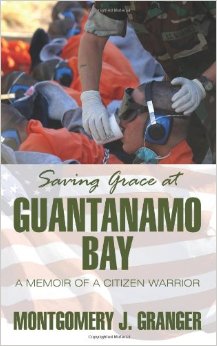
A Marine general was in charge of the operation briefly then, and Marines had helped stand up the mission at Camp X-Ray, and assisted in providing security and in-processing. In fact, the cover of my memoir about my time at Guantanamo Bay, taking care of bad guys, “Saving Grace at Guantanamo Bay,” shows a Marine guard giving water to a detainee, a display of compassion, which is the strength of a true Marine. Navy Corpsmen, assigned to the Marines at Gitmo were also front-and-center when my small liaison detachment arrived.
“Saving Grace at Guantanamo Bay: A Memoir of a Citizen Warrior,” by MAJ (RET) Montgomery J. Granger, former ranking US Army Medical Department officer with the Joint Detainee Operations Group, Joint Task Force 160, Guantanamo Bay, Cuba, FEB-JUN 2002.
Because transportation was sparse, and my unit vehicles were following us via slow moving barge from the US, rides to different locations were hard to come by. 15 passenger vans were highly valued, as to get from place to place could take hours by Gitmo bus or on foot; hitching rides became common place.
I swear to you, before my vehicle arrived from the US, the only people who would ALWAYS stop for me, a US Army captain, were the Marine Corps enlisted rank drivers of their 15 passenger vans. Would an Army driver stop, with 15 seats available? No. Navy? Nope. Even the Coast Guard would zip right by. But empty or full, the Marines would always stop: “Need a lift, Sir?” they would say cheerfully.
My opinion of Marines was strengthened by their work ethic and focus on training. Daily, as we crisscrossed the base at Gitmo, one would always see Marines training, in full gear, in full sun, day in, day out. Hand-to-hand combat, road march, formations, tactics, sometimes in triple digit heat, in the rain, wind, or . . . no snow, but it got a bit dicey out there during land crab mating season! The Marines were always there, working hard, ready for anything.
From stories my dad told about his time in the Navy on CV-60, the old Saratoga aircraft carrier in the mid 1950’s, I know that Marines guarded the Captain of every naval vessel, a holdover from back in the day when there were possible mutinies. My dad had an unintended face off with a Marine when he accidentally got too close to the Old Man. Marines were trusted loyalists.
I know that Marines are tasked with guarding presidents and foreign embassies.
I also know that little by little, those missions have been changed, especially the embassy security mission. From full battle rattle and Quick Reaction Forces, to civilian clothes and pistols, the Marine guard forces that defend our overseas missions has become a joke. All part of the, “Let’s get rid of the Marines” mission creep by the Left.
In my opinion, you only get one chance to make a good first impression, and to a bad guy scoping out embassy defenses, it’s no time to go small or go quiet. The only thing they shouldn’t know or see is how much of what and where we have to counter any attack. What they should see is well armed, well supplied killing machines, watching them and opposing them.
Geared-up US Marine embassy guards.
The principle of economy of force should not apply to Marine guards. The terms ‘robust’ and ‘deadly’ come to mind. Like at Abu Ghraib Prison in Iraq, in 2004-2005.
I spent several months at Abu Ghraib, where we held detained persons, and we had Marine guards on the walls and as a QRF. We also had contact with Marine Cobra helicopters nearby.
On April 2, 2005, the day after I left Abu Ghraib for another assignment, insurgents executed an anticipated attack, with rockets, mortars, crew served and small arms, and vehicle born improvised explosive devices (VBIEDs).
Main gate, Abu Ghraib Prison.
I was at the 18th MP Brigade Headquarters Tactical Operations Center (TOC), when calls came in from Abu Ghraib for support during an insurgent attack.
We had been briefed on the probable attack for weeks. They would block both avenues of approach to the prison, one on the north and the other on the south. They would attack the front gate and walls with VBIEDs. They would assault with ground forces in an attempt to liberate detained persons.
Later, security video and video obtained from a defeated enemy showed exactly that plan attempted. Enemy rockets were deployed from the approaches. VBIEDs hit the front gate and attempted to get close enough to breach the east wall of the prison, but failed.
About a battalion sized element approached from the east, but was defeated by the QRF, which, using small arms, crew served weapons and armored vehicles, came from inside the prison walls, identified, closed on and then killed the enemy, and then went back inside. A second wave of insurgents attacked from the same position, and again was defeated by the Marines in similar fashion.
Too late, Marine Corps Cobra attack helicopters arrived, only to find the battlefield without a living enemy to fight.
78 objects larger than a .50 cal. round were tracked inside the walls by Marine counter battery artillery radar. Not one US personnel were killed and all the attacking enemies were killed by the Marine guard force, saving my buddies and colleagues I had left back at the prison.
I remember having chow with several Marines during my time at Abu Ghraib. “How’s it going, Marine?” my fellow Army officers and I would ask.
“Could be better, Sir,” the dusty, sweaty and tired Marine would reply.
“How’s that, Marine?” We would say.
The Marine would reply, “We could be killing bad guys, Sir.”
Every morning at about 9:30 a.m., insurgents would fire into the prison from apartments overlooking our western flank. Marines in the guard towers on the walls were not allowed to open fire unless they could clearly identify an enemy threat. In other words, the Marine would need to see a bad guy, weapon in hand, actually firing at them in order to return fire lawfully. This caused immense consternation among the Marine guards, who were tasked with playing a deadly game of whack-a-mole.
If they fired at what they thought was an insurgent, it could actually be a civilian with a broom stick – which none of us put past the bad guys to do, just to frustrate the Marines. If a Marine fired and shot a bad guy, but one who was not armed or directly engaged in hostile activities, the Marine could be brought up on charges.
I felt bad for the Marines, who probably hated guard duty with a passion. I am sure they would have been much happier hunting and killing the enemy.
Our armed forces have seemingly always had Marines; our shock troops, our razor’s edge, our pride and joy.
Strategically, Marines are our best chance at ending conflicts before they begin, and ending them swiftly should they start. More robust than Navy SEALs, more capable and mobile than Green Berets, more deadly than Army Rangers or Airborne, Marines truly are ‘A breed apart.’
The United States Marine Corps came to be during a time when armed conflict sought first to influence the enemy through non combat tactics. The goal was to get the enemy to flee the battlefield in fear without battle. In fact, the Marines embody the ancient Chinese general Sun Tzu’s philosophy that the most skillful military is one who can subdue the enemy without battle.
This plays into the tactic of having robust, uniformed Marines at every embassy, enough to leave no doubt about their lethality or desire to rein terror down on any who would challenge them.
In the end, the best, most effective force is a balanced force. The Marines provide that balance, on the high end.
Yes, we have an Army, a Navy, an Air Force, a Coast Guard, and even a Space Force. Why on earth do we need Marines?
We need Marines because they are cut from a different cloth than the others (No disrespect intended, none take from this retired Army officer). They are one-track-minded – WIN!
Marines need to have all of the tools necessary to destroy an enemy incursion before it takes hold, or even happens. They need to be flexible (“Semper Gumby”), lightening fast, and deadly.
The term “Take no prisoners,” is one we often associate with the Marines. But they are aware of and compliant with the Law of War and the Geneva Conventions, sometimes grudgingly, but faithfully. A Marine will do as he or she is told, immediately, but not without understanding or appreciation for treating others with dignity and respect should they be captured. I saw this at Gitmo, I saw this at Abu Ghraib, and I have heard about it, many times, through stories, books and documentaries. Marines are gentlemen and ladies, even when they don’t want to be.
US Marines
It’s been said that you need the Army to hold the ground, but the Marines to take it.
I have considered it a great honor to have known and served with United States Marines. I actually wanted to be a Navy Corpsman so that I could serve with and heal them, but there was not a Navy Reserve base near enough to my home when I joined the service to accommodate that desire, so I did the next best thing: I became an Army Combat Medic (5 years), then Medical Service officer (17 years).
Some people have already made up their minds that the Marine Corps is outdated, unnecessary and redundant. To those people I say you are too WOKE to appreciate the most masculine force in the US military (not that females cannot or have not brought their own brand of fierceness to the Corps). The Marines are a breed apart, male or female, and embody all that we would want or expect in a force needed to make the enemy flee or be killed.
We need them on that wall. We want them on that wall, because without them, I for one would not sleep well at night.
Guard tower, Camp X-Ray, Guantanamo Bay, Cuba, winter 2002.
Please tell your Congressperson now, that you fully support keeping, preserving and modernizing our Marine Corps, both in their traditional role and for future OPS. Thank you!
“The opposite of love is not hate, it’s indifference.” – Elie Wiesel
Elie Wiesel
Who owns the words “Mengele,” Auschwitz,” “Hitler, “Nazi” and “Holocaust?”
Is it Jews? Poles? Germans? Russians? Gypsies? Slavs? Who?
I say it is all of the above and more.
The death toll in World War II, including those who perished in Nazi concentration camps, was nearly 85 million people world-wide, most in China and Russia. 6 million Jews disappeared in Nazi concentration camps, but also 5 million non-Jews, such as gay people, priests, gypsies, people with mental or physical disabilities, communists, trade unionists, Jehovah’s Witnesses, anarchists, Christians, Poles and other Slavic peoples, and resistance fighters, were also starved, worked to death, experimented on, tortured and murdered in these camps.
The “good” German was indifferent. The “good” German was silent.
Who spoke for the condemned, Jew or otherwise? Who speaks for them now? We all do. We all MUST.
Who owns the Holocaust? We all own it.
Our plague of cancel culture has reached a deadly crescendo. For uttering this word or that, no matter your status or context, there are those who would have your tongue.
If they had their way, cancel culture would clean up every errant thought and word from our brains, mouths and key strokes. How DARE we say and write politically and socially incorrect things? Who gave us that right?
American and other allied veterans who fought for the right to not only think different thoughts, but to speak our minds and hearts and souls as we see fit. They gave it. And they gave it with their blood, sweat, tears, limbs and lives.
My question is, who gave cancel culture the right to challenge my freedom of speech (and thought)?
It used to be we could agree to disagree and then go about our business, unharmed and proud in the knowledge that two people could actually disagree without ad hominem or hatred. No more.
Now, the thought crime of believing something out of the mainstream or cancel culture narrative can end your public communication privileges, and then weaken the collective mind.
Together, all thoughts, ideas, brainstorms and epiphanies can mean progress, discovery, insight, wisdom and VISION for a peaceful future. Being apart, segregated, censored, punished and alone we are doomed to repeat the ugliest and darkest times in our history. Why?
Because we weren’t allowed to speak; we weren’t allowed to utter the names and places and events that shall not be spoken but by a chosen, appropriate few.
Why?
Because someone may take offense, or suffer emotional trauma . . . because of the word, or because of the weakness of human emotions? Where is the objectivity?
Without speaking the unspeakable, or showing the unimaginable – the TRUTH, we are doomed to meet, in ignorant denial, a similar fate as did our ancestors. “It couldn’t possibly happen to us.” “They would never take our guns away.” “They would never attack our heritage, or rip down our monuments and memorials.” “I contribute to society, pay taxes, vote, and follow the law.” “Surely they would never treat us like the Jews and undesirables of the Second World War.” These are all famous last words.
When people begin to compare their wounds and wrongs, they lose sight of what’s more important, HUMANITY. A collective humanity demands basic rights of the individual to be heard, no matter the offense of the message, and especially if that message is painful.
Successful physical therapy includes PAIN TOLLERANCE. And without it, range of motion is lost. Viability is lost. Life is lost.
Learning history includes PAIN TOLLERANCE. Those who lack it fail to learn; fail to pass on essential life lessons. Those who say, “No, you can’t say that word or you will be silenced,” are least able to tolerate differences, change or grow. Why listen to them?
Is it better to listen to the one person who cries, “The Emperor has no clothes,” or to be cowed by the masses who claim the naked man is wonderfully dressed?
This is appeasement over substance; lies over truth.
This is what we are living now.
Imagine a world where thoughts were expressed and then people spoke, not to condemn the messenger, but to wax poetic on the message.
Those who attack the messenger don’t really care about the message as much as they care about hurting someone, anyone who is not part of the cabal, in order to preserve their own selfish thoughts. They aren’t mature enough to tolerate a different view. These are the people who should be shunned and then given a time out from the public square, not the lone truth tellers.
In medicine, if you don’t like what your doctor has to say, you can get a second or even third opinion – without being cancelled. Why then in society, social media, news programs, discussions or speeches, if we don’t like what is said, we are not allowed a second or third opinion?
If we eliminate the ability to speak the painful words, then we eliminate the ability to think about them. And when that happens, we expose ourselves to the evil ways of the past, and condemn ourselves to repeat the very deeds we say we abhor the most.
Rocky Point High School, Suffolk County, Long Island, NY, is a very patriotic place in a very patriotic community. Military veterans, volunteer firefighters, first responders, neighbors, and leaders of all kinds have contributed to myriad memorials and honors there since 9/11/2001.
The school boasts annual Veterans Day assemblies featuring veterans, high school band and small group music, multi-media presentations and rapt students.
The school has a 9/11 memorial outside it main entrance in honor of the sacrifice of community member on that day.
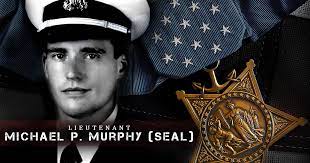
High School social studies teacher, coach and student leadership mentor, Mr. Rich Acritelli has spearheaded the school’s military honor wall, which highlight’s the school’s graduates who have joined the military service. This is in the main hallway and covers 50′ of surface on one side, and on the other facing wall is a similar tribute display for school staff members who have served. The picture plaques features color photos of the person in uniform along with their name and place in an are identified with their branch of service. There is also a small section dedicated to Navy LT Michael Murphy, a local deceased medal of honor winner from the War on Terror.
I have known Rich Acritelli for over 20 years, through high school athletics and then the military. Rich is a great friend and generous soul. I have been invited to speak at the annual Veterans Day Assembly a few times and am always impressed and amazed at the complete respect and sincerity of the students, staff and administration. The principal, Mr. Jonathan Hart was present for the entire ceremony and was engaged and supportive of Mr. Acritelli and the school participants and audience.
Mr. Acritelli told me I had 7-8 minutes for a speech to the audience of over 100 11th grade US History students. Rich has always been supportive of my service and a great fan of my book, “Saving Grace at Guantanamo Bay.” Here is my speech:
VETERANS DAY ASSEMBLY
ROCKY POINT HIGH SCHOOL
November 12, 2021
Good morning!
Thank you, Mr. Acritelli, and Principal Hart for inviting me here today to speak with you on the occasion of Veterans Day.
I am a three-times mobilized retired Army Major and served 22 years, starting out as a combat medic for five years, then Officer Candidate School, and then as a Medical Service Corps officer.
The last nine years of my service were spent in Military Police Enemy Prisoner of War liaison units, as the Field Medical Assistant, in charge of medical, preventive medical and environmental services for Enemy Prisoner of War operations.
After 9/11, I was deployed to Guantanamo Bay, Cuba, as the ranking US Army Medical Department officer with the Joint Detainee Operations Group, Joint Task Force 160. In short, I helped take care of bad guys.
After my retirement from the Army in 2008, I became very disappointed in the media coverage about Gitmo. I felt the media unfairly portrayed the operation as less than humane, which I knew was simply not true.
My colleagues and I, from all branches of the US military, Army, Air Force, Navy, Marines and the Coast Guard, were dedicated, well trained, and served with honor and integrity.
International Committee of the Red Cross physicians I worked with there told me, “No one does detention operations better than the US.” We were the best, and I knew it.
My frustration over the inaccurate reports about Gitmo led me to write a memoir about my time there called “Saving Grace at Guantanamo Bay.” It isn’t the whole story, but I like to think of it as a small piece to the big puzzle of the enigma we call Gitmo.
When last I spoke here I brought a few hard cover first edition copies of my book with me and donated them to the students and the school. I am here to do the same with the second edition, soft cover; one copy for Principal Hart as a dedication to your school library, and one to Mr. Acritelli to hold a raffle for interested students who might want a copy.
Not too long ago, a short documentary film was made about my experience at Gitmo, called “Heroes of Gitmo,” which is available on YouTube. Please check it out. Heroes of Gitmo.
I remember my service there as some of the most challenging times of my life, and I called it an emotional train wreck. In early 2002, at the beginning of the mission at Gitmo, we were told by then Secretary of Defense, Donald Rumsfeld, that even though the detainees, who were all at least unlawful combatants, were not entitled to the protections and privileges of the Geneva Conventions, we would treat them however, he said, “within the spirit of Geneva.” That’s all we needed to hear. We only trained one way, the right way. And even though we may have hated the detainees for taking us away from our families, friends and careers, we were duty bound to treat them with dignity and respect.
Detainees are given FREE, Qurans, prayer rugs and beads, white robes, beards, directions to Mecca, halal and Muslim holy holiday meals including lamb and baklava, services of US military Muslim chaplains, world class health, dental and vision care, recreation, books, TV, DVDs, correspondence, sports and more.
741 detainees have been released, about 39 remain and none have been executed or brutalized the way our enemies have treated US or allied prisoners. There is no moral comparison between Gitmo and how our enemies treat their captives.
With all this said, there was Enhanced Interrogation Techniques, or EIT performed on a handful of detainees at Gitmo in order to obtain valuable information that saved many lives. Those techniques have been labeled torture after the fact, and did not meet the internationally accepted definition of torture at the time. The techniques were not performed by Army personnel nor any Department of Defense personnel, but by CIA operatives trained in the techniques.
Torture is wrong, but at the time, the techniques used were legal and approved. Since then, the techniques have been outlawed and even though one technique, waterboarding, has been singled out as particularly cruel, it was used in Survival, Evasion, Resistance and Escape training for US personnel scheduled to deploy overseas who might be at risk of kidnapping by our enemies. The training was to help prepare US personnel for potential waterboarding by our enemies. It is not lethal unless performed by poorly trained individuals.
My advice to you though is to not take my word for it, but research for yourself about the US operation at Guantanamo Bay, which is still ongoing. There is plenty to read, but mostly from former detainees, trained to lie about their treatment in captivity. I know some of these men through social media, have read their books and shared mine with them. To this day, we agree to disagree about certain facts surrounding their participation in the Global War on Terror and their detention.
Veterans Day is a special day when we, as a society turn to say “thank you” to our veterans, who wrote a blank check to all of us for everything up to and including their lives. It’s been said that, greater love hath no one than this: that a person lay down their life for their friends.
Thank you for taking the time to honor me and the other veterans here today. I appreciate your kind attention and loyal support very much.
When you see a veteran, thank them for their service, welcome them home and ask them about their service. What job did they have? How was the food? Do you remember a funny story? Would you do it all over again?
Some veterans would jump at the chance to talk with a young person about their service, and some might not. But you never know unless you ask.
In closing, always remember to think for yourselves. Don’t let anyone discount your thoughts or feelings about things that are important to you. But be gracious in your conversations and seek to truly understand what the other person is trying to communicate. This takes patience, consideration and thoughtfulness. But don’t ever mistake kindness for weakness. It is the strongest among us who are also the most kind.
Thank you and God bless.
Montgomery J. Granger
Major, US Army, Retired
It was great to be a part of something so special with people who care so deeply about the sacrifice and dedication of veterans. Michael Murphy’s father, Dan was present and spoke before I did at the assembly. It was humbling to see a man so full of pride for his son, lost in the service of his country, taking up the standard of selfless service, honor and integrity – which his son displayed and demonstrated while in uniform in the service of his country.