End 17 #VeteranSuicides Per Day: VAGrok Gains Traction with Dartmouth’s AI Therapy Breakthrough

By MAJ (RET) Montgomery J. Granger (Health Services Administration) – Grok assisted

A few weeks ago, I wrote about the urgent need for AI innovation to tackle the veteran suicide crisis—17 of us lost daily, a number that haunts every vet who’s fought the VA’s maze of care. I pitched VAGrok, an AI chatbot to bridge the gaps, remember our stories, and cut through the bureaucracy that leaves too many behind. Since then, I’ve reached out to experts, pitched to my Congressman Nick LaLota (NY-1), and even scored an interview for a book on TBI, PTSD, and the VA disability circus. But today, there’s a new spark: Dartmouth’s groundbreaking AI therapy study, published March 27, 2025, in NEJM AI. It’s not just hope—it’s proof VAGrok could work.

In my last post, I laid bare the stakes: the VA’s continuity of care is a mess. Vets bounce between specialists, retell traumas to new faces, and watch records vanish in a system that’s more obstacle than lifeline. I envisioned VAGrok as an AI “wingman”—a tool with memory to track our care, flag risks, and fight for us when the system won’t. Then came Dartmouth’s Therabot trial: 106 people with depression, anxiety, or eating disorders used an AI chatbot for eight weeks. Results? A 51% drop in depression symptoms, 31% drop in anxiety—numbers that rival traditional therapy. Participants trusted it like a human therapist, and it delivered 24/7 support without the waitlists or stigma.

This isn’t sci-fi—it’s happening. Dartmouth’s team, led by Nicholas Jacobson, built Therabot with cognitive behavioral therapy (CBT) smarts and safety nets: if it spots suicidal thoughts, it prompts 911 or crisis lines instantly. For vets, this could mean an AI that knows your TBI triggers or PTSD flare-ups from last year, not just last week. Imagine VAGrok at Northport VA Medical Center, my proposed pilot site in NY-1: it could sync with VA records, alert docs to patterns, and talk us down in the dark hours when the 988 line feels too far.

The Dartmouth study backs what I’ve been shouting: AI can scale care where humans can’t. Jacobson notes there’s one mental health provider for every 1,600 patients with depression or anxiety in the U.S.—a gap the VA knows too well. Therabot’s not a replacement for therapists, but a partner. For vets, VAGrok could be that partner too—bridging the trust gap with memory the VA lacks. I’ve emailed Jacobson about teaming up; no reply yet, but the pieces are aligning.

Next steps? I’m pushing LaLota to pitch this to VA Secretary Doug Collins—his high-energy drive to fix the VA could make VAGrok a reality. The Dartmouth trial isn’t just data—it’s a lifeline we can grab. Vets deserve care that doesn’t forget us. VAGrok, fueled by breakthroughs like Therabot, could be how we get it. Thoughts? Hit me up—I’m all ears.

Fix Veterans’ Care Now – It’s Life or Death

We didn’t question the order to go to war, so why are we questioned about what the war did to us? 

We wrote a blank check and pledged our sacred honor for our country, but the Department of Veterans Affairs (VA) isn’t helping enough. Since September 11, 2001, over 130,000 veterans have ended their own lives.

One suicide is a tragedy. What do you call one hundred and thirty THOUSAND?

We need to fix the VA now because our lives depend on it.

In 2024, the VA spent $571 million to stop suicides. But where did the money go? Did it save anyone? I don’t see enough proof that it’s working. Worse, when we ask for help, the VA makes us tell our war stories over and over again. It hurts, and it’s not fair. The people deciding if I get help often never saw a battlefield. This messed-up system might be why so many of us feel lost, hopeless, helpless and then give up.

The numbers make me sick. Younger veterans, aged 18-35, are almost three times more likely to die by suicide than people who didn’t serve. For women veterans, it’s 2.5 times higher than other women. Even older veterans like me are hurting more than ever. If this happened at a company—where people were so miserable they hurt themselves—everyone would yell for change. I’m yelling for change now!

Here’s How I’d Start to Fix It:

Trust Me First: When I prove I served (verified DD-214), the VA should help me right away. I shouldn’t have to fight to show my pain came from war. I earned more respect than that.

Learn the Disney Way: Disney makes people happy with the attitude of second-to-none guest service and fun. The VA could train its administrators and staff through the Disney Institute to learn to treat me in a way that makes me feel like I matter and makes me smile.

Use Cool Tech: Things like facial recognition could say my name when I walk in and get me help faster in a personalized (and secure) way. Now, it’s “Last name? Last four social?” Without even looking up.

Make the VA Appealing: Turn VA facilities into welcoming experiences that project care: clean and green, curb appeal, emphasis on maintenance, warm/cool and comfortable, like coming home—like a resort. I’d want to go there, and it might sooth my stress.

Help All of Me: Don’t just fix my body—fix my mind, too! Focus on holistic wellness, not just medical treatment. Add gyms, pools, courts, fields, recreation, activities and groups where I can talk with other veterans. It could make me stronger, more fit and happier.

Be Honest and Quick: The VA needs to show where my money goes and stop making me wait years for help, or taking years to fix things. Waiting has left me and others with nothing—sometimes not even a home.

Bring in Military Helpers: Doctors, nurses, medical specialists, Corpsmen and medics from the Active Duty, National Guard and Reserves could work at the VA. They get what I’ve been through because they’ve been there too. Rotating in military medical personnel could also help retention and recruitment. If they see quality care up close and personal, they know what they are getting themselves into.

Make Asking for Help Normal: Don’t call the suicide hot line a “crisis line.” Just say, “Hurting? Call 988.” I’m not weak for needing help—I’m brave for asking. On the battlefield, one can hear a cry for help: “Medic!” “Corpsman!” That’s what we’re saying when we finally gather the courage to walk in through the front door.

We honor those who never came home by caring for those who did.

We can’t wait anymore. The VA promised to take care of every veteran with respect, dignity and urgency. Lincoln said, “Care for those who bore the battle,” not “Oh, only those parts the soldier can prove were affected by the battle, and oh, by the way, take a number.”

The VA cuts us up with a percentage of “disability” compensation and care. Imagine that? A percentage. Is that what we should have said prior to taking the hill? “Hey, Sarge, I only want to risk 10%, is that OK?”

It’s amazing that they bury the whole person, and not just the percentage they say died because of the war.

My question isn’t going away—I am raising my voice to hopefully make things happen!

We made an all-in bet for everything up to and including our lives. It’s time the VA made good on that bet.

Our dead comrades can’t tell you how they hurt, but we can. Please listen to us now.

What the Veterans Administration Should Be: An Open Letter to Donald Trump, Elon Musk, Vivek Ramaswamy, Pete Hegseth, and Rep. Nick LaLota (NY-1)

Gentlemen,

Our justice system operates on the principle that one is innocent until proven guilty. Why, then, does the Veterans Administration (VA) seem to operate under the opposite assumption when it comes to veterans’ care and disability ratings?

Upon verifying service through documents like the DD-214 and issuing an ID card, the VA should immediately assume veterans are entitled to care as promised by the very ethos of our military service: “To care for him who shall have borne the battle, and for his widow, and his orphan.” This statement by Abraham Lincoln in his second inaugural address at the end of the Civil War, carries no qualifiers; it’s a promise to care for all veterans, regardless of where they served or what they endured.

However, the current system is fundamentally flawed. Veterans are forced to spend considerable time and effort proving their ailments are service-related, which contradicts the unconditional service and sacrifices we’ve made. Veterans took an oath without caveats; we committed to follow orders, defend the Constitution, and potentially give our lives. In return, we should receive care without the burden of proof.

The administration of the VA by civilians lacking military or combat experience has been problematic. With Pete Hegseth potentially becoming the new Secretary of Defense, there’s hope for change. This matter should also resonate with President Trump, and I believe the Department of Government Efficiency (DOGE), under the influence of Elon Musk and Vivek Ramaswamy, could address these inefficiencies with common sense and innovation.

A New Philosophy for the VA:

Prioritization: The veteran should be the priority. Upon entering a VA facility, instead of the impersonal request for “Last Name and Last Four,” why not use modern technology like facial recognition and/or other biometrics for both security and personalized greetings? This would not only enhance security but also personalize and streamline the care process.

Efficiency and Technology: Implement integrated, high-tech systems to improve efficiency. Veterans should feel welcomed and valued, much like guests at a Disney resort where the business model is simple: treat every customer as a cherished guest.

Perception and Recruitment: The negative perception of the VA could deter potential recruits. If the VA were seen as a place where veterans are genuinely cared for, it might attract and keep more individuals to military service.

Facility Management and Care:

At Northport VA on Long Island, NY, the ongoing disrepair and delays in basic maintenance projects like HVAC systems or parking areas reflect a deeper issue of neglect. A 3-year, $21 million project, started in 2018, is still unfinished. These conditions not only degrade the quality of care but also demoralize veterans who must navigate an environment that seems to have forgotten them. Part of my 36-year career in education and education leadership involved public school facilities management. Some of the jobs in the capital projects plan for the Northport VA could have been completed in 6-8 weeks, rather than the current 6-8 years!

My personal health experience, after 22 years of military service including combat deployments, involves dealing with issues like hearing loss, tinnitus, sleep apnea, and PTSD, yet the process to receive care or compensation feels like an additional battle.

Rethinking VA Budgeting and Care:

The VA’s budgeting must be adaptive to the fluctuating needs of veterans, not constrained by typical government fiscal policies. The number of new claimants cannot be accurately predicted from year-to-year. It’s been over 16 years since I retired, and I am only now applying for a disability rating for the first time. Imagine the savings and improved care if we assumed veterans’ health issues were service-related unless proven otherwise? This shift could redefine the VA from an adversarial entity to one that truly supports and heals those who served.

I understand the current disability application system results in compensation, but what if I don’t need the money, just the care? Because the process is so arduous, complex and full of bureaucratic red tape, it could take months for approval, disapproval, appeals and other delays. Many veterans needlessly pay others to help them through the application process.

Conclusion:

I urge you to consider these changes, to let loose the capabilities of DOGE and the leadership of Pete Hegseth on this broken system. We should treat the whole person, not just the ailments deemed service-connected. A wholistic approach to healthcare is the most effective. Veterans have given much; it’s time the VA reflects this nation’s gratitude and commitment to our well-being by honoring Lincoln’s compassionate vision for veteran care.

Fixing the VA: What a Disney Approach Could Do

UPDATED: 6 February 2025

Drastic measures need to be taken with the VA, and the Disney Way may be a great approach.

Beyond the comical mouse & friends, lies a pinnacle of business acumen. Individuals and companies spend big bucks each year to learn the secrets of Disney customer service, management, logistics, maintenance and more at Disney Institute, aka, Disney University.

SaluteMickey

Everything about the Disney Company is special, and mostly successful. Of course, it’s all about the people, but then there’s the rub, isn’t it? The people make Disney special as much as the methods do.

I remember my father telling me repeatedly, as he would frequently stop a project to head to Sears for yet another Craftsman tool, “Right tool for the right job,” he would say.

One could easily say the same about people, or more specifically, employees. I could say, “Right person, right job saves time and money.”

Disney invests in the person. Disney invests training, health care, benefits, frequent raises and vertical movement. Disney means quality. Disney means care. Disney means success.

What part of this does the Veterans Administration not need?

Exactly, they need all of it and more, fast.

Sending VA executives, managers, health care professionals, technicians, clerical and volunteers to Disney Institute may seem unnecessary and overkill, but why shouldn’t our veterans receive five star treatment and customer service? Remember, it’s about people.

Disney could help in other ways as well. The whole VA experience could be Disneyfied, from upgrading automated appointment making, to streamlined pharmacy operations; smartbands and housekeeping, parking, cuisine and yes, even entertainment. If the point is to get the veteran to the VA, then why not make it into a place that they want to be?

Short of having Disney characters in costumes at VA hospitals, Disney could infuse a little magic into the experience with state-of-the-art technology, from entertainment opportunities, moving walkways, fresh fruit and vegetable kiosks, petting places (where small mammals could be handled by vets for stress reduction), fitness centers, fitness pools, Jacuzzi’s, spa’s, bowling alleys, art and dance studios, movie theaters, restaurants and coffee joints. OK, and maybe a meet & greet here and there?

Too frivolous, you say? Too expensive? How about the honorable veteran who wrote a blank check for everything up to and including his or her life so that you can stay at home with your family and maybe take a trip to Disney World while he or she was out in the boonies getting blown up? Too risky, too dangerous, you say? Well, that’s why we honor them, especially the fallen and severely injured. We honor them by taking care of all those who survive.

Zippity-Do-Dah!

How do you infuse a quick fix while we rotate VA staff through Disney University? You activate medical National Guard and Reserve troops. Most medical personnel in the military are Guard and Reserve personnel. These part-time warriors are full time civilian health care professionals and workers, and could easily assimilate into the world of the VA medical system.

In fact, years ago, when I was serving with a US Army Hospital Reserve unit, we worked our drill weekends in the local VA hospital, and sometimes at the local state university hospital. Like fish in water, these reservists would fit right in, like one big military family.

National Guard and Reserves typically do one weekend of service each month and then two weeks of training in the summer to meet minimum participation requirements. Why can’t this service be done in VA hospitals and medical facilities?

When I was hired by Disney back in the mid 1980’s for my dream job as a Davy Crockett Canoe ride attraction host at Disneyland in California, I went through Disney University (orientation). I will never forget the speech we got after watching the Disney Story in a small screening room. The lights came up and the trainer said, “So, what product does Disney sell?” Silence. “We sell happiness!” came the answer. “How do we sell happiness? By treating each person who walks through the front gates as if they were a guest in your own home.”

That was it. That was the secret to the Disney Way.

So, what’s so wrong with giving vets a little something they really deserve? A little happiness along with their health care. Vets have already paid for their E ticket, park hopper and annual pass; what’s left is a little TLC.

A holistic approach to health is always the best approach. A happy patient is a patient that has an exponentially better chance at recovery than an unhappy or depressed patient.

Even Disney has a dark side, and the dark side about the reality of the VA is that suicides amount to nearly 22 lives per day.

Let that sink in.

What business could survive if their customers committed suicide at a rate of 22 per day? The publicity alone would put them out of business.

My wife and family and I have been Disney Vacation Club owners since August 2001. We take a yearly pilgrimage to the House of Mouse and enjoy resort style living for a week or so. Occasionally, we will find ourselves at another amusement park or two here or there. And as soon as we walk through the front gates we think out loud to ourselves, that “It may be nice, but it ain’t Disney.”

The VA ain’t Disney.

But it could be.

Rethink the whole experience being mindful of the goal: health, wellness and happiness. That’s already part of the American way, with life liberty and the pursuit of happiness from our founding documents.  Did President Lincoln mean something less when he famously said we should, “Bind up the nation’s wounds; to care for him who shall have borne the battle, and for his widow, and his orphan,” pronouns notwithstanding.

We should think of “care for” in the broadest possible meaning. Whatever has been done in the past, and whatever is going on now, is not working. The bodies are piling up, and it’s time to think out of the government bureaucracy box and think more like the happy, successful people we should be.

Wrangle some VA Imagineers, seriously, and then let them run loose among the halls, walls and campuses of VA institutions and then turn them into resort and concierge style health care and beyond. They deserve it, and we can do it.

“It’s kind of fun to do the impossible.” – Walt Disney

NOTE: The author, Montgomery J. Granger is a retired educator of 36 years. He earned a BS Ed. from the University of Alabama in Health, Physical Education, Recreation and Dance in 1985, and earned an MA from Teachers College – Columbia University in Curriculum and Teaching in 1986. He substitute taught, K-12, in his home district in Southern California in 1986-87, when he worked weekends and holidays at Disneyland. He joined the US Army National Guard as a Combat Medic/Medical Specialist in 1986, and in 1991 became a Second Lieutenant in the US Army Medical Service Corps via Officer Candidate School, and spent the remaining 17 years as a Health Services officer. He retired from the Army Reserves in 2008 at the rank of Major, having served at Guantanamo Bay, Cuba, Ft. Dix, NJ, and in Iraq, on deployments in support of the Global War on Terror after 9/11/2001. He taught at various schools in New York City, including the Buckley School for Boys, where Donald Trump, Jr., and Richard Nixon’s grandson, Nicholas Cox were two of his students. He taught at Brandeis HS on the Upper West side of Manhattan, and then at the Bayard Rustin High School for Humanities in the Chelsea section of Manhattan, teaching health and physical education, coaching and serving as a Dean of Students. He became a school administrator in 1998 and attended the State University of New York at Stony Brook for School District Administrator certification. At various times and school districts in Suffolk County, Long Island, NY, he was Director of Health, Physical Education, Athletics, Health Services, Facilities and Security. He retired from education in 2022. He lives on Long Island with his wife of 31 years, also a retired educator, and his five children, now ages 29-16.

The Best Way to Honor Those Who Never Came Home: Take Care of Those Who Did

Michelle Obama, in her Open Letter to Veterans, published on Sept. 30, 2013, says, “If you are a veteran who is uninsured and hasn’t applied for [Veteran’s Administration] coverage, you may be eligible for [Obama] care through the VA.”

Yet the VA states if you have non-service related ailments or injuries, you don’t qualify for free coverage with the VA, fees and co-pays would apply.

The HealthCare.gov website Mrs. Obama recommends veterans go to stipulates that veterans who are enrolled in the VA system are considered “covered” and therefore do not qualify for care under the new health care law. Similarly, veterans who may be enrolled in Tri-Care, the military health care system, do not qualify to use the new Health Insurance Marketplace.

It’s no secret that “there are an estimated 1.3 million uninsured veterans,” according to Mrs. Obama’s letter. What may be a secret are the estimated 400,000 veterans suffering from Traumatic Brain Injury (TBI) – a leading cause of Post Traumatic Stress Disorder (PTSD), which can lead to social, physical, mental and emotional health complications, including suicide – which claims the lives of 22 veterans every day based on the VA’s own data reported by 21 states from 1999 through 2011. That’s one veteran every 65 minutes.

Mrs. Obama doesn’t even mention these two devastating conditions for veterans, their families and loved ones. The VA backlog and ill-equipped and trained VA service providers barely make a dent in helping those afflicted with TBI and PTSD.

What is the best way to honor our fallen heroes?

“Take care of those who came home,” is the answer given by Dr. Chrisanne Gordon, founder and chairwoman of the Resurrecting Lives Foundation and physical and rehabilitation physician. Who could disagree with making sure veterans, our most noble of citizens, who write a blank check to every man, woman and child in America for everything up to and including their lives, are cared for when they make it home alive?

Dr. Gordon, on her website, states that, “It is estimated that only 36 percent of the veterans returning from the Iraq & Afghanistan wars actually receive treatment through the Veterans Administration, although all are eligible.”

That’s only 792,000 out of 2.2 million returning veterans.

How will the Affordable Care Act provide relief for veterans if the VA can’t do it? How can Obamacare hope to even scratch the surface of treating ailments the government already can’t get out of its own way on?

The HealthCare.gov website claims that if a veteran can’t afford private health care coverage they “may be eligible for Medicaid.” The website also says that “if you’re a veteran who isn’t enrolled in VA benefits or other veteran’s health coverage, you can get coverage through the Health Insurance Marketplace.”

But is the Marketplace ready for these special needs patients? And if they are, can the veteran not enrolled in VA health care afford it?

“Getting coverage,” means “paying” for coverage through the Obama Care Marketplace. Why would a veteran, who qualifies for VA coverage, not go to the VA? It doesn’t make sense.

It’s as if Michelle Obama is trying to get “caring for veterans” points with a health care merry-go-round that will deposit the veteran exactly where s/he got on!

Veterans need to be directed to the VA, and then some need to have their hands held to even get them to sign up. Medicaid should cover the non-service related costs should the poor veteran not be able to afford these costs, however, because the Supreme Court ruled last year it would be up to the states to decide whether or not to implement Medicaid expansion, an estimated 284,000 poor veterans, who would have qualified for Medicaid under the expansion, will not be able to access it.

Obamacare has NOTHING for the veteran, nor should it. But why the smoke and mirrors towards those who already are faced with a daunting, bureaucratic labyrinth and well deserved mistrust of the efficiency of a government program?

It’s a shame that in this age of returning veterans with complex health care issues we can’t find a better way to address their needs than with just a confusing “open letter” to them about something that can do nothing for them.

What we need is to allow veterans to seek out treatment at any municipal health care facility, just like Medicaid patients can do. Restricting care for veterans only through the ridiculous bottleneck of Veterans Administration facilities, which are inaccessible to most veterans who tend to live far from these facilities, for an estimated 400,000 suffering the effects of service-related TBI alone, is trite, myopic, unnecessary and a dishonor to their sacrifice.

I am the author of “Saving Grace at Guantanamo Bay: A Memoir of a Citizen Warrior,” and three times mobilized U.S. Army Reserve Major (Retired). Author web page: http://sbpra.com/montgomeryjgranger/ Twitter @mjgranger1

Congress Reacts to Military Mental and Brain Health Issues: Will You?

When U.S. senators from two political parties come together to introduce legislation, without argument or hesitation, one should take notice.

In the current climate, when political opposites attract one might think money, prestige, or influence are involved, but in the case of the bill to improve military mental health evaluations for service members, Sen.s Rob Portman (R-Ohio) and Jay Rockefeller (D-W.Va.), no such benefits await them. They appear to have only altruistic and patriotic motivation for seeing that our heroes receive the comprehensive medical attention they need and deserve.

The Medical Evaluations Parity for Service Members Act of 2014 (S. 2231 or MEPS Act,) states that before anyone can become enlisted or receive a commission in the armed forces of the United States they shall receive a “mental health assessment” that will be a “baseline for any subsequent mental health evaluations.”

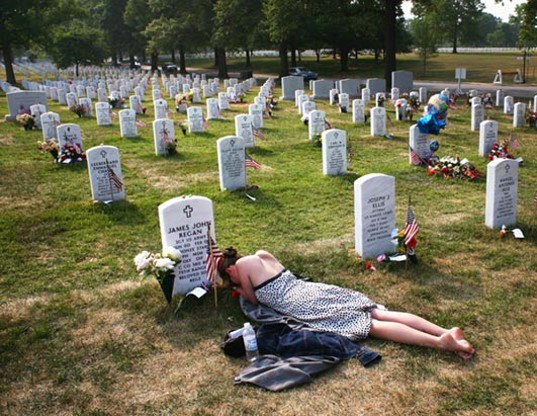
Alex Burgess gets emotional while visiting the gravesite of an old friend who was killed in Iraq, in section 60 at Arlington Cemetery, May 27, 2013 in Arlington, Virginia. For Memorial Day President Obama layed a wreath at the Tomb of the Unknowns, paying tribute to military veterans past and present who have served and sacrificed their lives for their country.  (Photo by Mark Wilson/Getty Images)

This would bring mental health and “brain health” issues to parity with the physical evaluations conducted prior to admittance into the military.

If passed, the law would also include a comprehensive physical and mental and brain health evaluation when the service member comes off of at least 180 days of active duty or separates from the service. This would include screening for Traumatic Brain Injury, recently found to cause most instances of Post Traumatic Stress, which could lead to Post Traumatic Stress Disorder. TBI is a “brain hurt” as opposed to a “mind hurt” issue that is more physiologic than mental.

We are finally addressing TBI issues, the signature issues of our returning heroes. Brain injury is not synonymous with “mental illness,” and the treatments for mental illness are often detrimental to TBI, hence the distinction is very important.

It is estimated that over 400,000 Global War on Terror veterans suffer from TBI, and most go undiagnosed and untreated, which leads to PTS and then possible PTSD.

AP photo.

Veteran and former U.S. Army Military Police non-commissioned officer, Curtis Armstrong was given a routine exit physical which didn’t connect the dots between his symptoms of memory loss, headaches, and thought process problems, since identified as being associated with TBI.

We can all imagine that if you’re not looking for something, and don’t know what it looks like even if you were, you’re not going to find anything. That’s exactly what happened to Curtis, and hundreds of thousands of his comrades.

The Resurrecting Lives Foundation, founded by Dr. Chrisanne Gordon, has been trying to gain the attention of politicians in Washington, D.C., for several years now. They have a panel of experts and have been advocating for the establishment of proper screening and treatment for veterans with TBI. Moving forward, the most encouraging event to date has been the MEPS Act introduction in the Senate.

When I inquired as to the catalyst for Sen. Portman’s introduction of the MEPS bill his staff replied:

“[T]he MEPS Act is a response to the clear need for better monitoring and assessing of service members’ mental health. While recent tragedies like the shootings at Fort Hood and the Navy Yard raised the profile of these issues, the need to address it has been apparent for far too long…Last summer, Senator Portman’s [Homeland Security and Government Affairs Committee] subcommittee held a hearing on improving access to health care, including mental health care, for rural veterans. To help correct this, Sen. Portman introduced an amendment to the FY14 defense authorization bill requiring [the Department of Defense] to report on the current status of telehealth initiatives within [the Department of Defense] and plans to integrate them into the military health care system. Sen. Portman and Sen. Rockefeller also attempted to introduce language requiring mental health screenings for exiting service members. This language is now included as part of the MEPS Act.”

At the risk of seeming too giddy about these latest developments, which bring not just mental health, but “brain health” issues of military personnel into a broader light, it has been far too long that these issues have stayed in the shadows.

Soldiers like Curtis deserve better, and we as a country need to pay close attention to how we can help. Encouraging our own legislators, local, state and national, to support and pass the MEPS Act is just a start; there needs to be more resources allocated to ensuring our best and brightest are also well cared for, especially after their deployment service has ended.

AP

Among the several professional organizations endorsing this bill is the Academy of Physical Medicine and Rehabilitation. According to Dr. Gordon, rehabilitation specialists would be included in the evaluations and in the program of reintegration.

“Sen. Portman did that, inviting collaboration with the private sector – the way to solve the TBI epidemic,” she said.

We can’t afford a legacy of forgotten warriors. We cannot endure the nightmare of neglected veterans. We are better than that. We, each of us, have an obligation to care for those we depended on to protect our ideals and us. Nothing less than a full accounting of every suffering veteran should be acceptable.

The Veterans Administration can be a hero here instead of the villian. If Secretary of Veterans Affairs retired general Eric Shinseki would pay attention to what’s going on in Congress, he could beat legislators to the punch: He could ask for funds to implement the essence of the MEPS Act within VA policy and practice.

Beginning with the new fiscal year in October 2014, he could seize the initiative in the war against mental and brain health issues in the military. You could suggest this to your legislators when you encourage them to sign on as co-sponsors and then pass the MEPS Act.

It’s important to remember that enshrining mental health evaluations for military personnel in law would ensure implementation in a timely manner, but if the MEPS Act gets held up in committee or is defeated, having the VA move forward with policy and practice changes through budgetary requests for fiscal year 2015 would honor the commitment our heroes deserve and should expect.

I am the author of “Saving Grace at Guantanamo Bay: A Memoir of a Citizen Warrior,” and three times mobilized U.S. Army Reserve Major (Retired). Twitter @mjgranger1.

IT’S EVERY AMERICAN’S RESPONSIBILITY TO HELP OUR VETERANS HEAL (as posted by me in The Blaze: http://www.theblaze.com/contributions/healing-the-veteran-brain/)

Imagine that you volunteered to protect and defend your country. Imagine that while you were performing this heroic act you were injured. And then imagine that when you returned to those whom you fought for, you were unable to receive the care and treatment you needed to become whole again.

How would you feel about that?

Most of us have a hard time imagining those things, but few of us would agree that the returning veteran should be left without hope, drug abused, jobless, on the street, confused, suicidal or homicidal. Yet that’s what many of our brothers and sisters at arms face, as 1.3 million Operation Enduring Freedom (Afghanistan) and Operation Iraqi Freedom veterans take their own lives every day.

On Veterans Day, Its Every Americans Responsibility to Help Our Veterans Heal

Nearly half a million suffer from mild or full-blown Traumatic Brain Injury, which has recently been proven to cause Post Traumatic Stress, or it’s debilitating next-of-kin, Post Traumatic Stress Disorder.

The tragedy occurs not because you don’t care, but because not enough key people care enough to DO something about it. Recent studies have proven that even a mild brain injury can have debilitating physical effects on the brain up to and including post traumatic stress disorder.

This is a brain hurt, not a mind hurt. It needs to treated with an “integrative” approach, and NOT with psychotropic drugs, which may contribute to other problems, including suicide and homicide.

What we don’t know can kill these veterans.

Veterans and active military personnel cannot heal themselves, although their direct participation in the integrative approach is essential to their eventual improvement. This approach includes physical medicine specialists, neurologists, psychologists, physical and occupational therapists, speech therapists and social workers.

It should not include psychiatrists who overwhelmingly treat patients with mind-altering drugs that have proven ineffective in helping brain injuries or PTSD patients (because it’s a brain INJURY problem), and have in many cases just made things worse.

The education of the masses is important, but perhaps more important is the education of those who can do the most good NOW. These are state, national and local representativeshospital executivesmilitary and medical military commanders, financial and commercial leaders, and of course YOU. And you are the linchpin because you have the power to motivate your representatives and other key leaders to pay attention to this epidemic, “signature injury” of Global War on Terror military personnel.

On Veterans Day, Its Every Americans Responsibility to Help Our Veterans Heal

The Resurrecting Lives Foundation is hosting a documentary film screening for members of Congress on Nov. 12, 2013, at the Capital Visitors Center at 3:00 p.m. The documentary reveals the epidemic of TBI and provides a road map to helping the estimated 500,000 military personnel affected by this injury. You can help by INSISTING that YOUR representatives in Washington, D.C., attend this screening. Please visit the links and then share them your representatives and community leaders TODAY.

Your action and participation just may save the life of someone who risked theirs for you. If you’ve ever wondered how on earth you could possibly ever repay our brave men and women in uniform, who’ve sacrificed so much for us, well, now you have it. Remember, we honor those who never made it home by caring for those who did.