Forget everything you thought you knew about money.
In the end, your monetary system should be a barter system, exchanging one thing of value for another thing of value. That’s fair and equitable.
That’s how the monetary system of the United States was imagined. With Roger Sherman, member of Congress, monetary scientist and in favor of tariffs and a national bank, helped write the finance sections of the Constitution, Article I, Sections 8 & 10.
These passages establish the who, what and how of our monetary foundation, which included weights and measures, gold and silver as a backing for our currency and Congressional control.
Where we went wrong was in allowing private banking interests to confiscate the wealth of our nation with the Federal Reserve Act of 1913. The Federal Reserve (FED) is neither federal (it is listed as a private business) nor a reserve (any gold it holds is not ours) of anything, and it is owned by US and global banking interests, not the American people. The shares of the FED cannot be bought on the market or sold but earn interest on debt owed by every US citizen of the bankrupted United States, payable to the owners of the FED.
By 1971 the gold standard was gone, and so was the promise to pay in lawful money on our currency, once “US Notes,” now “Federal Reserve Notes” (a monetary “note” is a promise to pay, not payment in and of itself). The dollar, which was a measure of a certain amount of gold or silver, became the thing for which it was a measure.

Think of a gallon becoming milk instead of a gallon of milk. Absurd, right? Not if you change things over generations.
Today, our all-debt money system works because we have been conditioned to think and believe that the paper money or the “dollars” we spend have value. In fact, they have only psychological value, where once they held intrinsic value, like in a true barter system.
But now, because about 90 percent of all M1 (money in circulation) is zeroes and ones (digital), it can be created out of thin air, based on imagination, not a tangible thing.
Why not return to a gold standard and use precious metals to back our money? Currently, that would be impractical, as these things are sold as commodities, which rise and fall in value based on market pressures, supply and demand. You would need any country willing to trade with us to agree on a standard weight, measure and value of these metals for a legitimate monetary system to work.

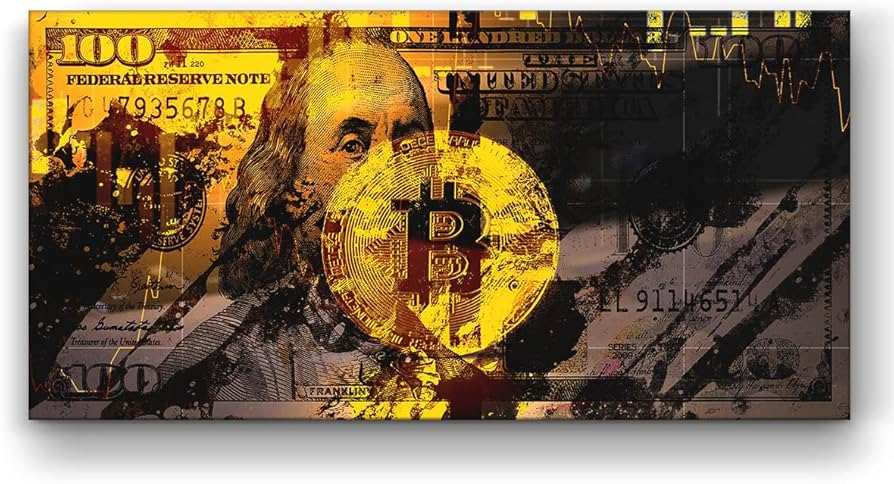
So, what’s with crypto and Bitcoin? These are simply notional currencies, just like the digitized dollar, only they pretend to have value, again, based on market pressures of supply and demand.
Bitcoin fans would argue that because there is a finite amount of Bitcoin, 21 million “coins,” they will hold and increase in value. Bitcoin is “made” when “miners” solve cryptographic puzzles to add new blocks to the blockchain (a shared, immutable ledger that facilitates the process of recording transactions and tracking assets in a business network). This process rewards them with new bitcoins and transaction fees. Over time, the issuance of new bitcoins decreases, ensuring a finite supply. Bitcoin mining takes a lot of energy and physical assets, which they say adds to the legitimacy of the process, which is decentralized.
But imagine a Native American trading in wampum (seashells), being told there was a new money, but you can’t touch, taste, see, smell or make nice clattering sounds with it!

Bitcoin works now only because laws allow it. But wait and see, at some point it will become regulated. Why? Because the government always gets its cut. Corrupt politicians and the rich elite can’t pass up the temptation to make money by creating something out of thin air, just like our former fractional reserve banking system.
Banks in this system needed only have a “fraction” of the money on hand in order to loan out much more, say reserves of $1,000 in order to loan out $9,000. That’s right! They could create $9,000 out of thin air and then loan it out at interest, making free money for themselves. The more they loan, the more they earn. But the interest on that $9,000 was never created. What does that mean to a monetary system?
If the interest on a loan is never created, then at some point someone has got to default on their loan because there isn’t enough money in circulation to accommodate the repayment of all loans plus interest, it means the money has to come from somewhere, but where? Enter the government and the FED. The more the government spends, the more money there is in circulation. The more government borrows, the more interest is owed, causing inflation.
But, news flash! Since March 2020, the fractional reserve amount required of FED member banks is now ZERO PERCENT. That’s right, a bank is allowed to loan money it does not have, all of it, creating a bonus of interest payments for itself.
Member banks have to “buy” FED stock equal to 6% of their paid-up capital and surplus. But they only have to put up 3% to the FED; the other 3% is “callable.” That entitles the member bank to dividends from earned interest on government securities, but only up to 6%.
Most people think banks can only loan out what they keep on deposit from checking and savings accounts. The truth is, checking and savings accounts are bank LIABILITIES. That’s right, it is money they OWE, so they can’t spend it or loan it out because it’s not their money. Banks only make money on fees and interest on loans and other holdings, and dividends from FED stock.
Shocked? Did you never learn this in school? This system guarantees that the wealthy get wealthier. It guarantees that some percentage of borrowers will always end up in default, losing their loan collateral to the banks.
That’s what happened in the housing bubble burst in 2008. Home loans were cheaper than dirt and loan officers were told to give, give, give, so that when they borrower defaulted they could collect, collect, collect. Only when the defaults rolled in did people simply walk away from loans, leaving the loaning institutions in the lurch and failing, but with lots of real estate no one could afford!
Two of the biggest loaners (and losers) were government loaning institutions, affectionately known as Freddie Mack and Fannie Mae. The government should only be involved in the loan business if the government owns the central bank. Ours does not. Ours borrows from the private central bank known as the FED.
That’s right, We the People used to own our money system, controlled by Congress, our representatives, whose feet we could hold to the fire if things got out of control. No more. If you ask your congressional representatives about our money system they will refer you to the Federal Reserve, when they should be referring you to the Constitution.
Roger Sherman, one of the Founding Fathers and a signatory of the Declaration of Independence, played a critical role in shaping the financial and monetary principles of the United States. His views on monetary policy, often rooted in economic pragmatism and fairness, align with the constitutional provisions in Article I, Sections 8 and 10, which govern Congress’s powers over money and the monetary limitations on states. Let’s delve into these topics:
Roger Sherman’s Perspective on Money
Advocate for Sound Money:
Sherman was a proponent of “sound money,” meaning money backed by tangible assets like gold or silver.
In his 1752 pamphlet, A Caveat Against Injustice, Sherman warned against the dangers of fiat money (currency not backed by physical commodities) and decried the unfairness of paper money schemes that often led to inflation and economic instability.
In the beginning, gold smiths charged owners of gold to keep the metal safe, and issued receipts that the owners began to use as currency in the economy. After a while, gold smiths, or our first bankers, learned they could create receipts for gold they did not have, and then spend them into the economy. Eventually, short bankers were hung from tall trees once owners of gold discovered the bankers had created false receipts which were brought in, reducing the amount of gold on hand.
Principles of Honest Trade:
Sherman believed that money should be a stable medium of exchange and a store of value to ensure fairness in trade and prevent fraud or devaluation.
Article I, Section 8: Monetary Powers of Congress
This section grants Congress the following powers relevant to monetary science:
“To coin Money, regulate the Value thereof, and of foreign Coin”:
Congress holds the exclusive authority to mint coins and establish their value, creating a uniform national currency.
This clause aims to standardize currency across states, preventing the chaos of competing currencies and varying values.
“To provide for the Punishment of counterfeiting the Securities and current Coin of the United States”:
Counterfeiting disrupts economic stability, and Congress’s power to penalize it upholds the integrity of the monetary system.
Relevance to Sherman’s Views:
Sherman’s insistence on precious metals (gold and silver) as the standard for currency aligns with the Constitution’s granting of monetary authority to Congress to ensure reliability and stability in currency value.
Article I, Section 10: Monetary Limitations on States
This section restricts state monetary practices:
“No State shall… coin Money; emit Bills of Credit; make any Thing but gold and silver Coin a Tender in Payment of Debts”:
Prohibition on State Currencies: States cannot issue their own currency or print paper money (bills of credit). This prevents the monetary fragmentation and instability experienced under the Articles of Confederation.
Gold and Silver as Legal Tender: States are limited to gold and silver as legal tender for debts, reflecting Sherman’s argument that precious metals are the most stable and just form of money.
Rationale:
These restrictions centralize monetary authority under Congress to ensure uniformity and prevent inflationary policies or economic manipulation by individual states.
Monetary Science Implications
Standardized Currency:
By centralizing the creation and regulation of money under Congress, the Constitution ensures a single, standardized currency for the nation. This promotes economic efficiency and trust in the monetary system.
Intrinsic Value of Money:
Sherman’s preference for gold and silver reflects an intrinsic value approach, where the monetary unit derives its worth from physical commodities. This contrasts with modern fiat currencies, whose value is based on government backing and public trust.
Inflation and Stability:
The framers’ restrictions on states and emphasis on gold and silver were responses to the rampant inflation caused by overissued paper money during the Revolutionary War period.
The Role of Congress:
Congress’s power to regulate currency values ties into its broader economic responsibilities, such as managing interstate commerce and the national debt.
Roger Sherman’s Legacy
Sherman’s advocacy for a stable, commodity-based monetary system influenced the framers’ decision to enshrine gold and silver as the monetary standard for states. While the U.S. has since shifted to a fiat currency system (with the Gold Standard abandoned in 1971), Sherman’s principles highlight the foundational goals of fairness, stability, and trust in the monetary system.
The principles codified in Article I, Sections 8 and 10 continue to reflect the balance between central monetary authority and limitations designed to prevent economic instability—a balance Sherman deeply cared about.

Yet with the FED in charge, all profits or “dividends” paid to the holders of Federal Reserve stock from interest paid on government securities and the National Debt go to banking interests, not the American people.
That has got to change.
Our money system was designed to do the work of economic stability and prosperity for the people, not the banking interests. Certain of our Founding Fathers were concerned about this, including Thomas Jefferson.

We need to reclaim our money system from the FED and design a legitimate barter system based on an agreed upon gold (and silver) standard.
Remember that Wall Street is merely Las Vegas without the lights. Adults are entitled to their entertainment, and if you choose to spend your hard earned cash on speculation, that’s your choice, but the average American citizen should be allowed to avoid speculation and invest in their future using solid, accountable, stable currency that will hold its value.
We need to avoid the gambler’s temptation for crypto and Bitcoin, and stick with and strengthen the dollar, returning to US Notes and a true United States central bank that is of, by and for the people, dedicated to life, liberty, property and the pursuit of happiness.
Tell your congressional representatives that you are “Mad as hell,” and you’re “not going to take it anymore!” They, Congress is our “legitimate avenue of redress of [our] grievances.” Let them know who you are, what you expect, and that you will be following up and voting according to their response and action.
 Saving Grace at Guantanamo Bay