Women In Combat: Debate Should Be Over

I submitted this piece to a local newspaper after reading several editorial opinion pieces on why women should not be allowed in combat.

The debate on women in combat rages on, but what most people don’t know is that the battle has been over for some time, which is why the Joint Chiefs of Staff have recommended changes that will now simply become formally approved. Since Operation Just Cause in Panama in December 1989, when several U.S. Army Military Police (MP) Officers, including Cpt. Linda Bray of the 519th MP Battalion, faced combat when securing Panamanian Defense Forces installations, women have performed brilliantly in battle. Their participation in just Cause was eventually not recognized as combat by the Defense Department because they were not legally allowed to be in combat.

Since that time many women have advanced through the MP ranks in combat support roles, including most notably Gen. Janis Karpinski (Operation Iraqi Freedom), our own (and former colleague of mine) Lt. Col. Jackie Gordon (Operations Noble Eagle, Enduring Freedom (2 tours), and Iraqi Freedom, and a Suffolk County public school counselor and Babylon Town Legislator), and Sgt. Leigh Ann Hester, who was awarded the Silver Star medal for her exemplary performance during a battle to protect an ambushed convoy just south of Baghdad, Iraq in March, 2005. At that time I was stationed in Baghdad at the 18th MP Brigade headquarters. The brigade was responsible for all detainee and convoy security and I watched the security video of then Specialist Hester in the battle. Her calm, cool and deliberate actions, in the face of a well-armed and superior force of insurgents helped save the lives of the convoy personnel and her comrades.

More than just proving in battle that they are capable, these women and thousands of others endure the same Army training to get where they are. After three mobilizations since 9/11/01, and after three cycles of rigorous pre-deployment training that I went through, I can personally attest that men and women in the Army from all MOS (Military Occupational Specialty) backgrounds train together, in all conditions, including very physically demanding battle simulation lanes training and live fire convoy and defense training.

In the early 1990’s combat exclusions for women were lifted in the Air Force and Navy, allowing women in those services to serve in combat aircraft and on combat warships, respectively. Also, in 1994, rules were changed in the Army to allow women in combat support Military Police units that could serve on the front lines. That, in essence began the test that led to the Joint Chief’s recommendation.

Women in combat are nothing new. Over the past 24+ years they have proven time and again their value and capability to not only make the grade, but also excel on the battlefield, in the air, and on the seas. The only thing causing a stir now is that these accomplishments have not grasped the attention or imagination of the mainstream media or the public at large. But that’s OK. The military women who have faced and will face combat in the defense of their nation don’t really care about all that, their reward comes in knowing and being able to prove they can in battle.
What to Do About School Security in the Age of Deranged Shooters

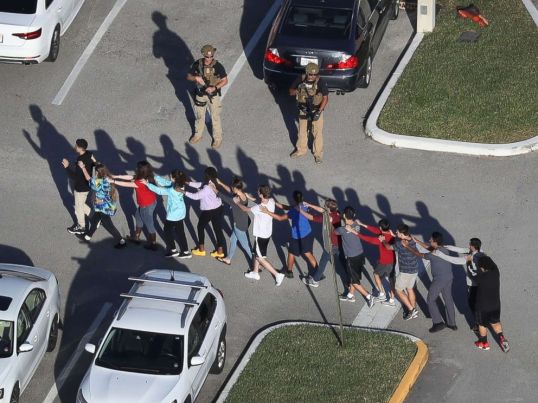
What’s more important than your family’s safety and security? And what is more important to you when your children are at school than their safety and security? So why is it we see more and better physical security for neighborhood banks and jewelry stores than we do for our public schools? Are money and jewels more valuable to us than our children?

parkland-florida-school-shooting-07-gty-jc-180214_4x3_992

If you’re like me, the answers to those questions are obvious, but the solutions in public schools are more complex than they should be because of an irrational political correctness that ascribes more to fantasy perceptions than to unfortunate realities. However, in terms of physical security, what’s good for one is not always good for all, or even most. Each community must decide for itself a comfortable level of security. We cannot wait, nor should we expect our federal government to weigh in on better security for our children at school through a national gun control initiative. There’s so much more to the issue than that convenient cloak under which are hidden myriad other contributing factors as to why or how a young gunman did what he did.

If the problem is security, then the solution must address that issue in order to be effective. Everything else is secondary. The fact is that all shooters plan their attack; whether for a few hours or for up to several years, they plan exactly what they want do, when, and how, and then rehearse it, if only in their minds. They envision themselves being successful, which feeds their sick motivation to actually carry out the crime.

Shooters select targets that are “soft,” or appear to carry a higher probability of success than for failure. Nothing would be worse for the perpetrator than failing to execute their depraved fantasy. So, the critical task in preparing to discourage similar attacks than what took place at Sandy Hook Elementary School is to “harden” the potential target, or at least give the appearance and impression that if chosen, it would be less likely that an attack would be successful.

How to do this when normal protective security practices cannot take place at public schools, such as varying one’s schedule and being unpredictable in day-to-day operations? Boys and girls arrive at the same time, via the same transportation system every day. They also take recess, out door physical education, and athletics at predictable and reliable times each day, usually in the open on favorable weather days. Again, the goal is to harden potential targets; nothing is going to completely protect a child at school unless you make them into what some would call prisons, but making the opportunities available to a potential shooter fewer, and his potential success less likely are the goals.

While in Iraq, I was part of dozens of convoys, some short, some long, but each one, whether it was near or far, was unique. Planning was detailed and exhaustive, but each thing we did, or didn’t do, we knew would contribute to either our potential success or failure, and failure was not an option. We knew bad guys were out there, watching us, learning from our behavior, so we were constantly evaluating our performance on security. Schools need to do the same thing.

Currently, public schools drill more for fires than any other potential hazard, and that comes from a history of horrible fires. But the time has come to add intruder drills that focus on best practice protection and reaction, in cooperation with local law enforcement and emergency response agencies – the groups that would most likely be first responders to an incident. Since schools practice at least a dozen fire evacuation drills each year, escaping rather than locking down as a best way to avoid an active shooter could be incorporated into the drills: lock the doors, and then escape through a second means of egress, already required by fire safety code, and then rally at a predetermined location off-campus.

Schools need to employ security experts, like those at R.R.I.S.C. (Rescue Recovery Investigation Security Consulting – http://www.rriscm.com) who will work with administrators, teachers, support staff, parents and students so that they feel prepared should the unthinkable happen. (And if it can happen in Newtown Connecticut, it can happen anywhere. It’s a new age, and one that won’t pass anytime soon.) Consulting with professionals can lead to innovative and effective plans that can save lives in active shooter situations. One solution may be to employ a company like R.R.I.S.C. to train school staff to perform their own protection services and employ a quick reaction force (QRF) for active shooter situations. A QRF could aid local law enforcement in isolating and then eliminating an armed threat. They could also perform triage and traumatic first aid care while protecting wounded victims from further harm. Good candidates for QRF responders could be teachers and administrators, but school support staff, such as custodians, maintenance mechanics, grounds keepers, clerical, school aides, hall monitors, and security staff, some of whom may be former military, may provide an excellent resource for enhanced school protection. Teachers must stay with their students in the classroom, so training them to use firearms for protection makes sense. A potential shooter who wants to enter a classroom by force would be met with force, causing a failure or at least a delay in his plans.

Politics be damned: we can’t afford to sit around and argue about motive, gun control, mental health, violent video games, etc. We need to keep our schools safe and secure, and we do that by hardening them with physical security devices and personnel who will present an undesirable target for a potential shooter. We want the shooter to pick someplace else. If everyone had that attitude then the shooter’s fantasy would have to remain just that.

In the mean time, approach your local school district board members and administrators and then ask them what they are doing to make the school facilities hard targets, and undesirable settings for potential intruders. Hold their feet to the fire and organize with parent groups, such as the PTA, booster club, or alumni associations. Offer to help pay for a professional physical security risk assessment, and then follow-up by asking what more can be done to keep your children safe in school. Lives depend on it, maybe even your own child’s.

Keep Gitmo Open

Gitmo remains the best, safest, most secure place for unlawful combatant Islamist extremists who want to kill us. 9/11/01 REALLY happened. 13 terrorist attack attempts on Manhattan were REALLY thwarted. A terrorist attack inside Ft. Hood, Texas, REALLY took place. Benghazi REALLY happened. We are at war, a Global War on Terror/struggle against Islamist extremists. And until al Qaeda, the Taliban, and other terrorist/extremists put their hands up and their weapons down, and promise never to kill or harm or destroy again, we will remain at war. Gitmo is a legal, professional and appropriate place for detainees, and calling for its closure gives aid and comfort to the enemy, and clouds the serious purpose of the finest military detention facility in the world.

Military Commission due process for KSM et. al., is unprecedented

(Author’s Note: The statement below is in response to an April 9, 2012, editorial in the Long Island, New York newspaper, Newsday, which can be found at http://www.newsday.com/opinion/9-11-terror-trials-it-s-about-time-1.3647063 )

Dear Editor,

The delay you mention in “On al-Qaida trials, it’s about time” [Editorials, April 9], regarding Khalid Sheikh Mohammed’s (KSM) prosecution was due largely to first, a two year wait for the Supreme Court to rule on legal challenges from the left, and second, a re-writing of the Military Commission’s Act (MCA) of 2006, due to extended political and legal challenges from the left.  Our current MCA of 2009 is governing the proceedings, not the aforementioned as you state in your editorial.  You also fail to mention what “due process” means in the context of the Commissions.  The newest MCA gives unlawful combatants unprecedented extra legal privileges, and these new privileges include “presumption of innocence until convicted beyond a reasonable doubt.”  A quick visit to http://www.mc.mil allows a fingertip study of U.S. military commissions, their origins, history, and current application.  It’s worth a look to see that there is virtually NO DIFFERENCE between a U.S. Courts-Martial, U.S. Federal Court proceedings, and a Military Commission, to the advantage of our enemies; how could this not be, in your words, “optimal?”  And optimal for whom, us or KSM?  By the way, the Nuremberg trials of World War II lasted about four years (1945-1949), and suffered no delay due to attempts to extend extra legal privileges to Nazis, and took place AFTER the end of hostilities. May I remind Newsday we are still very much in armed violent struggle with Islamist extremists, like KSM, who want to kill us.

Apologize for burning Qurans?

(Author’s note: The following is an unedited response of mine to an editorial recently published in my regional newspaper. Here’s a link to the edited version published in Newsday on 3/7/12 http://www.newsday.com/opinion/letters/letters-pulling-out-of-afghanistan-1.3583573 )

Dear Editor,

Your editorial in the Tuesday, February 28 issue of Newsday, titled “Afghanistan: Get out soon; Quran burning, killings of U.S. soldiers underscore hostilities between ‘allies,’” makes it sound as if we don’t have troops in 70 other countries, CIA in over 90 countries, and Diplomatic Security Service in over 200 countries, in our struggle against Islamist extremists.  Iraq and Afghanistan amount to the high ground in this struggle, much like Germany and Japan were the high ground in World War II.  Would you have us leave those places, too?

The fact is there are still many people out there who very much want to kill us.  Our ability to project power and influence through places like Afghanistan help keep us safe here in the U.S., just like staying in Germany helped protect us against the Soviet threat, and a presence in Japan helps us deter a Chinese threat.  Our presence in those two countries allowed them to rebuild, retool, and focus on social and infrastructure priorities, while we subsidized, and still do subsidize their defense.

There is now pressure from NATO to invade Syria to stop the now year-long bloodshed; the death toll of innocent victims approaches nearly twice that of all the American deaths associated with ten years of battle in Iraq.  Since Barack Hussein Obama insisted on an untimely withdrawal from neighboring Iraq to please a hungry election year electorate, we now have no adjacent physical military presence with which to directly influence the ongoing tragedy there, or with Iran.  Our troops in Afghanistan dwindling and scheduled for full withdrawal, have no hope of influencing actions in Iran, which threaten to worsen, and invites an Israeli pre-emptive strike.

As for the desecrated Quran burnings, you know, but did not put in your editorial, that detainees had written in the books, which is strictly forbidden in Muslim teachings and against camp rules.  Although it is permissible to burn a damaged Quran, it is not preferable, and would require “rubbing out” references to Allah, His Angels and His Messengers before burning.  The Qurans had been deemed classified material because of the detainee writings in them, and were probably therefore scheduled to be destroyed along with other classified documents.

While serving at the U.S. detention facility in Guantanamo Bay, Cuba in 2002, I received briefings on the Muslim faith, which included cursory information on the proper handling of the Quran, but they did not include how to properly dispose of one.  Such details would be left for the U.S. Navy Muslim Chaplain on duty there.  I doubt the soldiers tasked with disposing of the books had any clue what they were doing would upset anyone.

I agree that we should apologize for inadvertently desecrating the Quran, precisely when all Taliban and al Qaeda apologize for every single American and other innocent human being they have killed, from Marine CPL Stephen Crowley, a Long Island native, and U.S. Embassy Guard in Islamabad, Pakistan, the first American casualty in the Global War on Terror, killed on November 21, 1979, to the victims of 9/11/01, whose numbers keep growing from the hazards of the response and clean-up at the World Trade Center, to Daniel Pearl’s video taped beheading, to the execution of the two U.S. Army officers you mention in your editorial.  When they do that, we should apologize for the books, not before.

The reality is that al Qaeda and the Taliban and their ilk will never apologize for anything they do.  As the Barbary Pirates before them, they are set on death and destruction in order to influence weaker forces into their realm of influence.  The murderous Islamist extremist protestors in this case have seized the President’s premature and unwarranted apology as a weakness, and have exploited it with the help of a traitorous media.  In what sane world to we excuse the murder of innocent people because of the incineration of paper?  Sincere religious followers understand that the sins of an individual are atoned between that person and their God, not avenged through a murderous crowd or individual.

NOTE: I am a three times mobilized retired U.S. Army Reserve Major, who served in Cuba and Iraq, and am the author of “Saving Grace at Guantanamo Bay: A Memoir of a Citizen Warrior.”

It was cold. Desert cold.

It was cold.  Desert cold.  Probably in the low 70’s, but after a day near 100 in the shade, it was cold.  Some wore their uniform to the shower, some went in PT’s.  Almost all went wearing flip-flops.

There is no light (light discipline, don’t you know?).  You cannot see.  You’ve been this route so many times before you could do it with your eyes closed, so it doesn’t really matter.  Your body is on auto-pilot anyway, counting the steps without you, and then up the stairs of the trailer (you’re lucky; on this FOB you have a trailer).  Your arm reaches up, your hand turns the knob and FLASH!  You’re blinded by the light.

The trailer is air conditioned.  You freeze.  Shivering, you wait for the water to warm up.  It never does.  You suck it up, quickly poking in, and then out of the water.  You soap up.  Liquid ice rinses you off . . . until: “Hey, that’s not cold.” “Aaaaaaaaaahhhhhhh!!!!!!!”

The scalded parts of your body are red.  As you stumble out of the trailer, and the door self-closes behind you, you almost fall down the stairs because now you are completely blind.  The large gravel hurts under your flimsy .99 cent PX flip-flops.  The siren goes off.  You run to the bunker, losing a flip-flop on the way.  Now the gravel REALLY hurts.

The mortars fly in.  One here.   One there.  You feel the WHOOSH of the concussion, and the sound is right next to you, but it could be a mile away.  You’re either dead, or you’re not.  You remember your first “incoming” in-country.  You waited for the all-clear.  And you waited.  Until it occurred to you that there was no such thing as “all clear” in-country.  It’s never safe.

You make it back to your hooch.  Fall into your bed (you have a BED, not a cot in a tent, like you had for six months out THERE).  It’s so soft.  Your head hits your pillow, or does it?

Your mind wanders.  Instantly you are alone, in a space craft, small as an Indy car, tight, but cozy.  You’re warm now, and it’s dark, but you see the stars through your canopy, some rushing by, some so far away they look still, very still.  You focus on one, one far away, and it’s blue, and green, and white.

You are getting sleepy in your dream.

You feel a warm tingle, an excitement almost.  You know . . . you are going home.  And you weep.  You weep as only you can when you’re alone, and feeling alone, amidst a billion stars.

As you remember having set the auto-pilot, cryogenics takes over.  You feel safe, and warm, and good.  Home.  You’re going home.

“Captain!”

“Who said that?”  You whisper a scream.  You keep your eyes closed, because you know if you open them, well, it won’t be good.

“Captain!”  The drill sergeant-like voice roars.

You know who said it now.  And you still don’t want to open your eyes.

The fist of the drill sergeant-like voice is now pounding on the door of your hooch.

You know they know you know.

“Damn!”  What did I forget now?

“Mail.”  The voice is sane now.

You fly out of bed, open the door and snatch the letter.  “Letter?”  It’s smooth.  It’s cool.  The blast of heat from outside says it’s nearly midday.  You slept.  You slept hard, for the first time since . . . .

You don’t have to read the return address.  The smell tells you who it is and you just sniff it.  The envelope flies off the  folded page inside, and there it is:  Cursive, perfect, writing.  Curled and curved beautifully; and slanted just so.  The words don’t even matter.  You crumble around it, pressing it to your nose and face, letting it become part of you, tears staining the page.

“I Love You,” it said.  “I Love You,” you say.

It’s so hot it hurts to hold your 16.  You hate wearing the Nomex gloves because, well, damnit, because it’s just too damn suffocating is all.  If you’re not in a fire-fight . . . you’re not in a fire-fight.  You’re back on the FOB, how long now, weeks?  Out THERE.

You have to take a convoy in to Anaconda to coordinate some psych services for the boys who saw their buddy die yesterday.  You need a ”Team” or a member of a team.  You could do it yourself, but you know you’re not a professional at it.  But you could do it.  Sit there, looking at them looking at you.  Blank stares, but stares full of . . . full of a lifetime, or at least a life.  A life taken, snatched; kidnapped under fire, under explosion, under blood.

The trip takes four weeks, or an hour, or somewhere in between.  It doesn’t matter because you’re there now.

You walk around aimlessly, but find who you’re looking for.  Tell them what you need to tell them, and then walk into the MWR.  It has the feel of a renovated airplane hangar.  The inner room is a theater, pitch as a moonless night.  Outside the room, sit/lay grunts.  They are dusty, dirty, sweaty.  They are toast, from the toaster of the bright orange heat tab in the sky.  You know that “tired.”  You have been that tired.  You are that tired.  You go into the theater and seek refuge.  You seek protection.

It is pitch as a moonless night.  Quiet as a mouse, except for the voices coming from the screen, and the soft gentle chorus of snores.  There are no seats left, and everyone is . . . asleep.

Detainees Earned No Extra Legal Privileges

Over 400,000 lawful Prisoners of War were held in the United States during World War II without one call for extra legal privileges for them.  Habeas corpus was suspended then for dry foot German saboteurs, who were captured, tried by military commission, and then most executed, all within four weeks time.  Why is it then, when all Americans have been targets for Islamist extremists since the death of Marine CPL Stephen Crowley in Islamabad, Pakistan, back on November 21, 1979, when he was murdered by one when the U.S. embassy there was stormed by bussed-in radicals (later to be funded by Osamma bin Laden) on false news reports the U.S. had seized the mosque at Mecca, in Saudi Arabia, and after Iranian “students” had seized the U.S. embassy in Teheran, Iran weeks before, on news that the Shah of Iran had been allowed into the United States for treatment of an illness, and fast forward to today, when we have troops in 75 countries (including those we defeated in WWII), CIA in over 90 countries, and Diplomatic Security Service in over 200 countries, that we pay so much attention to a comparative handful of UNLAWFUL COMBATANT Islamist extremists who want to kill us?  These detainees BROKE Geneva Convention rules, and our own Law of Land Warfare (US Army Field Manual 27-10 Warfare http://ac-support.europe.umuc.edu/~nstanton/FM27-10.htm ) during war time, and BY LAW have earned NO EXTRA LEGAL PRIVILEGES.  Also BY LAW, they can be held “until the end of hostilities.”  Where is the sanity in even discussing what should become of them?  They have ZERO rights, according to LAW.  But, because they are held by the benevolent, kind, generous, and moral United States of America, they are treated within the spirit of Geneva, and in accordance with DoD policy (by which they have due process rights – see Military Commissions Act  http://www.defense.gov/news/commissionsacts.html ), and in accordance with U.S. Army Regulations governing the care and treatment of detainees. All Gitmo detainees are lucky to be alive, let alone realistically hoping to receive extra legal privileges.  The International Committee of the Red Cross (ICRC) have told me on two separate occasions, once in Guantanamo Bay, Cuba, and once in Iraq, that “nobody does [detention operations] better than the U.S.”  The detainees are at Gitmo so long as they either pose a risk or are suspected of having valuable information that may aid us in our effort to win the Global War on Terror (Struggle Against Islamist Extremists).

What’s it like to take care of people who want to kill you?

“Saving Grace at Guantanamo Bay: A Memoir of a Citizen Warrior”

“Hard as it is to believe, one of the most significant stories of the post-9/11 age is also one of the least known, life at Gitmo, the detention facility for many of the world’s worst terrorists. Few individuals are more qualified to tell this story than Montgomery Granger, a citizen soldier, family man, dedicated educator, and Army Reserve medical officer involved in one of the most intriguing military missions of our time. Saving Grace at Guantanamo Bay is about that historic experience, and it relates not only what it was like for Granger to live and work at Gitmo, but about the sacrifices made by him and his fellow Reservists serving around the world.”

Andrew Carroll, editor of the New York Times bestsellers War Letters and Behind the Lines

Saving Grace at Guantanamo Bay, or “Gitmo: The Real Story,” is a “good history of medical, security, and intelligence aspects of Gitmo; also, it will be valuable for anyone assigned to a Gitmo-like facility.”

Jason Wetzel, Field Historian, Office of Army Reserve History

Then U.S. Army Reserve Captain Montgomery J. Granger found himself the ranking Army Medical Department officer wiht the Joint Detainee Operations Group (JDOG) on a joint mission like no other before it; taking care of terrorists and murderers just months after the horrors of September 11, 2001. Granger and his fellow Reservists end up running the JDOG at Guantanamo Bay’s infamous Camp X-Ray. In this moving memoir, Granger writes about his feelings of guilt over leaving his two-day-old son, Theodore, his family and job back home.  While in Guantanamo, he faces myriad torturous emotions and self-doubt, at once hating the inmates he is nonetheless duty bound to care for and protect. Through long distance love, and much heartache, Granger finds a way to keep his sanity and dignity. Saving Grace at Guantanamo Bay is his story.

Montgomery J. Granger is a three-time mobilized U.S. Army Reserve Major (Ret.) who resides in Long Island, New York, with his wife and five children. Granger is the author of “Theodore,” a personal narrative published in the 2006 Random House wartime anthology, “Operation Homecoming: Iraq, Afghanistan and the Home Front in the words of U.S. Troops and their Families.”